

Product Releases
and Updates
Building AI agents is exciting—until you need to prove they actually work. When you're iterating on a System Prompt, updating Grounding Data, or wiring up new tools, the only way to know if things still behave correctly has been manual, one-off testing. Change the prompt logic, re-deploy, and hope for the best. That kind of guesswork doesn't scale, and it certainly doesn't inspire the confidence needed to put agents in front of real users.
We saw a clear need for a structured, repeatable way to validate agent behavior during development—something that lets you know, before anything reaches production, whether your changes improved things or broke them.
Introducing Evaluations in Agent Workbench
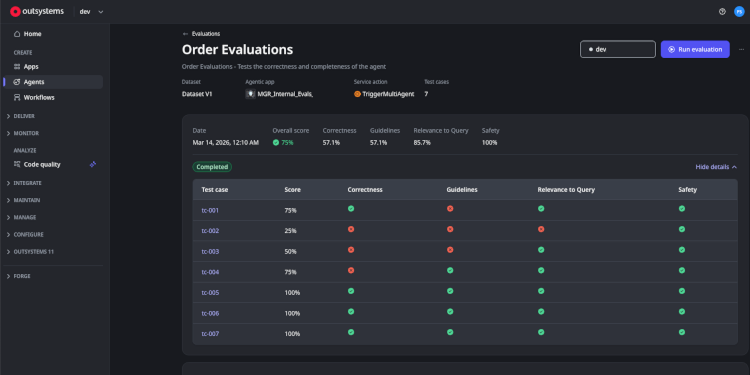
Evaluations let you automatically test your Agent Logic against a Golden Dataset—a collection of test cases with inputs, expected outputs, and expected tool calls that you define. You upload the dataset as JSON, select the Service Action that wraps your agent, and run an evaluation. The platform executes each test case, captures a full execution trace (inputs, tool calls, token usage, and final output), and then automatically scores every result using the built-in platform Judge. No configuration needed—every run gets a quality score and Pass/Fail for each test case out of the box.
This means you can change a prompt, swap a tool, or adjust grounding logic and immediately see how those changes affect accuracy and reliability across dozens of scenarios. The full execution trace gives you the visibility to pinpoint exactly where things went wrong—which tool was called, what arguments were passed, and what the agent actually produced. And because the Judge runs automatically on every evaluation, you get consistent, comparable feedback across runs without any extra setup.
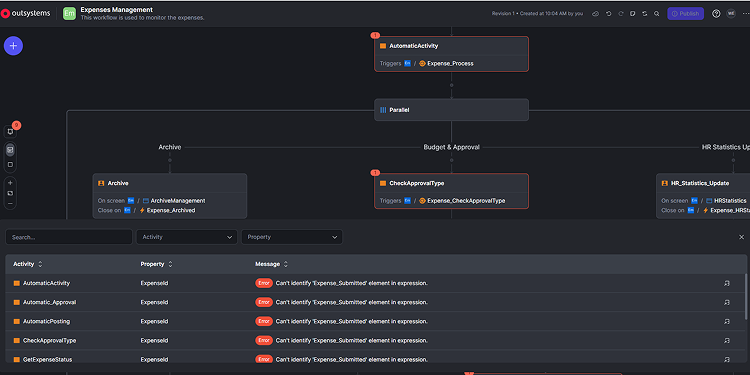
We’re introducing a new widget for error management in OutSystems Developer Cloud (ODC) Workflows: a new, visually intuitive panel that helps you quickly identify and resolve issues while building workflows.
Located at the bottom of the Workflow Editor, the Notification Panel aggregates all workflow errors in one place. Instead of navigating through multiple activities and properties to track down issues, you can now instantly see where problems exist and jump directly to them with a single click.
A notification indicator shows the number of errors detected in your workflow. Clicking it opens the Notification Panel, where you can:
- Identify issues at a glance – View a clear summary of all workflow errors in one place.
- Jump directly to the problem – Click any error to navigate straight to the affected node.
- Resolve issues faster – Reduce debugging time and avoid manually searching across the workflow.
With improved visibility, navigation, and filtering, this feature makes workflow creation smoother and more efficient—so you can spend less time debugging and more time delivering value.
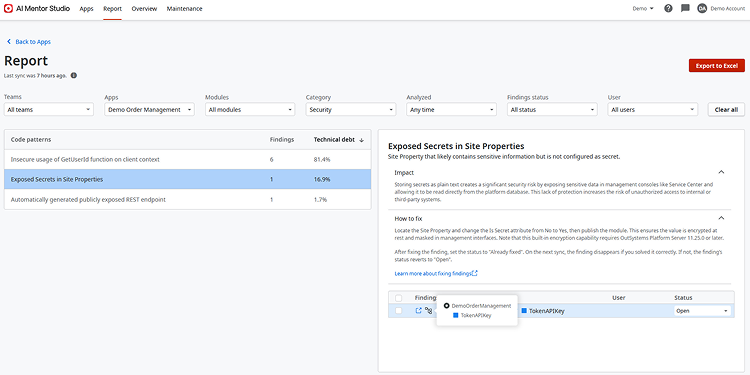
Storing API keys and external service credentials in site properties is a common practice, but leaving them unencrypted creates a significant security vulnerability. Relying on manual reviews to catch these oversights is risky and often leads to overlooked vulnerabilities in O11 apps.
AI Mentor Studio now automatically identifies these risks by matching site property values against typical formats for sensitive credentials and API keys.
By flagging exposed secrets early, teams can prevent accidental data exposure, enforce encryption best practices as well as ensure their applications remain compliant with modern security frameworks.
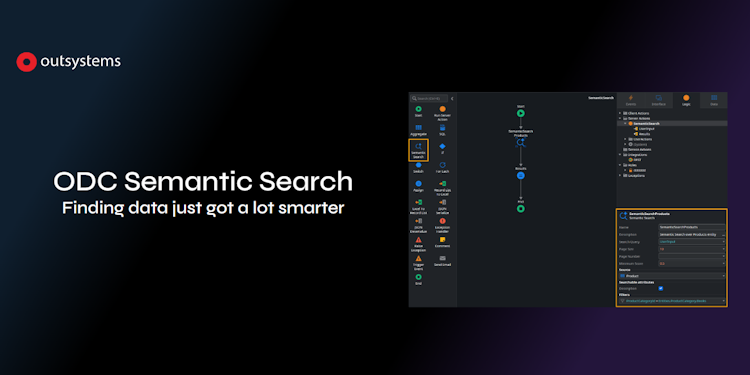
We are thrilled to announce the Beta release of ODC Semantic Search, a powerful new AI capability that helps applications and AI agents find relevant information based on meaning, not just exact keyword matches.
Introducing ODC Semantic Search
Traditional search relies on exact word matches, which can miss what a user is really looking for. Semantic Search uses vector-based retrieval to understand the meaning and context behind a query. This enables your applications to surface the most relevant information based on concepts, even when the search terms don't perfectly match the data in your OutSystems database. By transforming existing text attributes into searchable vectors, you can finally unlock the full potential of your ODC data.
Powering Apps and AI Agents
Semantic Search is more than a search experience; it is a foundational capability for building the next generation of AI-powered applications and experiences.
- Enhanced user experiences - Deliver more natural, human-like search experiences in web and mobile apps, helping users find relevant information faster and with less effort.
- Grounded AI agents and RAG - Support Retrieval-Augmented Generation (RAG) patterns by supplying AI agents with the most relevant context from your ODC data. This helps improve response quality by making AI outputs more relevant, more trustworthy, and better grounded in your business information.
Regional Support & Data Handling
For ODC environments residing in unsupported AWS regions, search requests will be automatically and securely redirected to a supported region to ensure full functionality. Learn more about it in the documentation.
Get started today
Semantic Search is currently available in Beta - we’re excited for you to try it and share feedback with us. Contact your account team and learn how to enable this powerful AI capability.
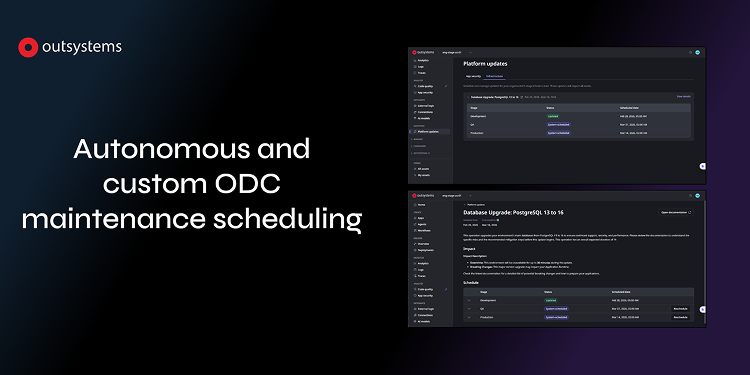
We’re pleased to announce that you can now autonomously schedule the database upgrades, security patching, and other maintenance tasks directly in the ODC Portal. The custom maintenance scheduling empowers teams to align infrastructure updates with their specific business needs, ensuring that system reliability and compliance never come at the cost of operational agility.
With this update, you get a unified maintenance dashboard with real-time progress tracking, allowing administrators to flexibly reschedule pending operations to a specific date and time within available maintenance periods. To ensure you never miss a critical update, the system sends proactive email alerts for required actions. It includes an automated fallback mechanism that securely executes necessary updates before their deadlines if no rescheduling is performed.
You can find upcoming updates and patches for app vulnerabilities under Maintain > Platform updates (formerly under App security).
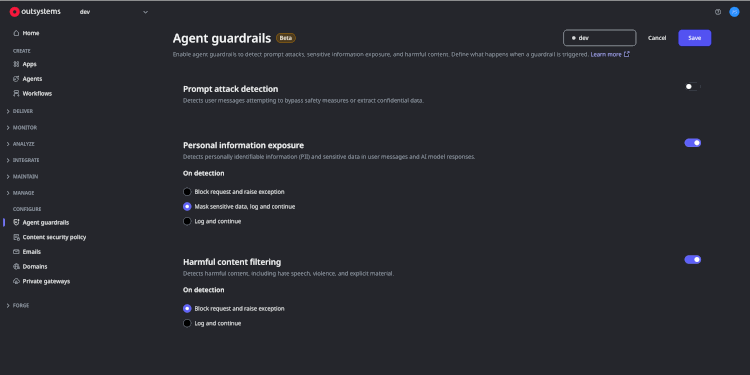
When you only have a few agents, running them without built-in safety checks might be fine. But as teams ship more agentic apps with Agent Workbench, it becomes hard to answer basic questions at scale: How do we block profanity or filter personally identifiable information? How do we prevent prompt injection and ensure our AI usage adheres to internal policies?
With this release, Agent Workbench now provides a built-in way to validate what goes into and comes out of an Agent’s LLM calls—so guardrails can be applied directly in the platform, not bolted on later.
To support governance and compliance at scale, we built a foundation that lets organizations enable predefined safety rules and lets developers apply them to specific Agents. This provides an initial layer of control and trust today—and sets the stage for more advanced, mandatory governance over time.
Introducing Agent Guardrails
Agent Guardrails are shared safety and compliance controls that validate what an AI Agent can receive (inputs) and produce (outputs), so teams can scale agent usage without increasing risk. System Administrator can configure the following predefined Guardrail Rules:
- Content Safety: Detects and blocks harmful, unsafe, or policy-violating content in prompts or responses.
- PII Filtering: Identifies sensitive data (e.g., personal identifiers) and masks or blocks it to prevent leakage.
- Prompt Injection Prevention: Detects attempts to override instructions, exfiltrate data, or manipulate the agent’s behavior.
When an Agent runs, Guardrails automatically validate its inputs and outputs against the active rules. If a rule is violated, the system can:
- Block the response,
- Mask sensitive content, or
- Log the event (based on configuration).
You also get diagnostics that show which rules ran, what happened, and whether each check passed or failed—making it faster to troubleshoot and validate agent behavior against your policies.
Agent Guardrails is available in Beta—we’re excited for you to try it and share feedback. More improvements are already underway and coming soon
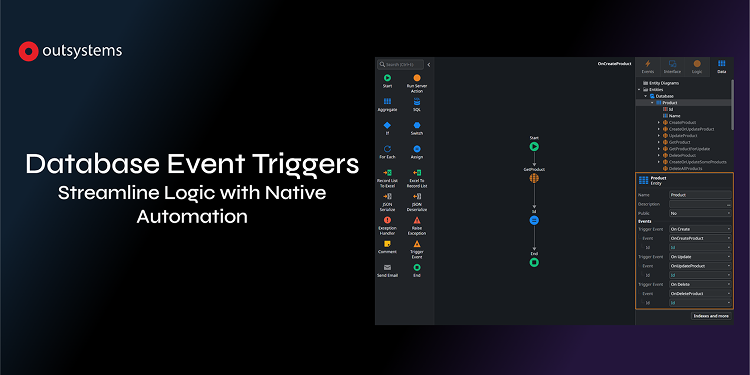
Following the success of our Event-Driven Architecture (EDA), we are excited to expand your toolkit with Database Events, a new capability exclusive to OutSystems Developer Cloud (ODC). While EDA allows for high-level application orchestration, this update specifically enables developers to build highly decoupled, reactive applications by triggering logic directly from database state changes, eliminating the need for manual wrappers or complex process modeling.
With this release, you can now trigger events based on native entity events—OnCreate, OnUpdate, and OnDelete—turning your database into an active participant in your application's architecture.
Key Features
- Native Entity Triggers: Directly subscribe to data changes at the source. Logic is automatically invoked whenever a record is created, modified, or removed.
- Asynchronous Execution: All database-triggered logic runs in the background. This ensures that your main user transactions remain fast and responsive, as the system doesn't wait for side-effect logic to complete.
- Access via Record ID: Each event provides access to the unique Identifier of the affected record. This allows you to easily retrieve the latest state to perform audits, handle cache invalidation, or stream data to external systems in real-time.
- Enhanced Reliability: Ensure that critical side effects—like audit logging or external data synchronization—happen every single time a record changes, regardless of where that change originated in your app.
- Seamless Studio Integration & Availability: Configure these triggers directly within ODC Studio under the Entity properties. This feature is currently rolling out to all ODC tenants; look for the new Events section under the properties of any Database Entity.
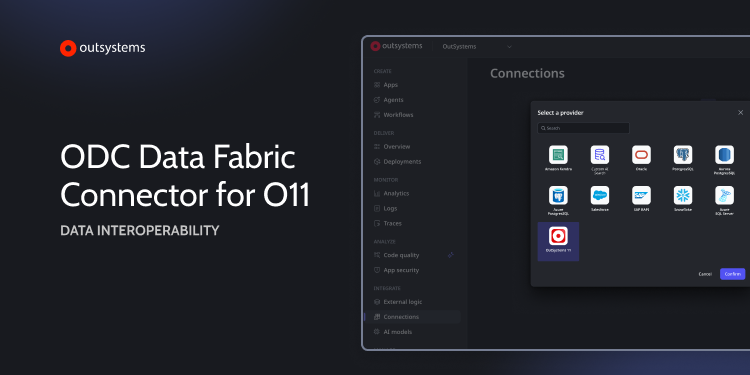
We have enhanced the recently released ODC Data Fabric Connector for O11 to support O11 multi-pipeline infrastructures (multiple production environments in the same infrastructure). This update is specifically for enterprise customers who manage development and delivery across segregated business lines or regional pipelines.
What has changed:
- Pipeline Interoperability: You can now expose entities from different O11 pipelines into an ODC tenant.
- Architectural Consistency: Maintain your existing O11 deployment and segregation rules while bridging data to ODC.
This update enables organizations with complex delivery architectures to use the connector to ground ODC-based AI agents and applications in their core business data residing in O11.
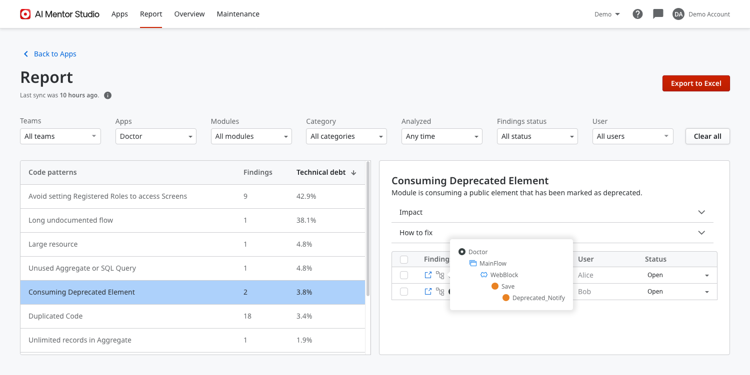
Identify outdated components automatically to reduce technical debt and security risks.
Manually auditing applications for deprecated elements is a tedious process that often leads to overlooked technical debt. AI Mentor Studio now proactively flags when your modules consume elements that are no longer recommended, so these can be replaced with more secure or efficient alternatives.
By identifying these risks early, teams can improve application health, minimize vulnerabilities, and simplify future upgrades.
OutSystems is now FedRAMP compliant, providing U.S. federal agencies and federal contractors with an authorized, full-stack custom application development platform for deploying and managing mission-critical applications that meet the government’s data security requirements.
This milestone allows government organizations to incrementally modernize legacy systems and deploy cloud-native applications while meeting FedRAMP Moderate federal security requirements.
A rigorous and exclusive U.S. government program, FedRAMP is designed to standardize security assessment and authorization for cloud service offerings, accelerating the adoption of government-grade cloud solutions by federal agencies. OutSystems has partnered with Knox, the largest and longest-running managed federal cloud provider, to achieve FedRAMP Authorization.