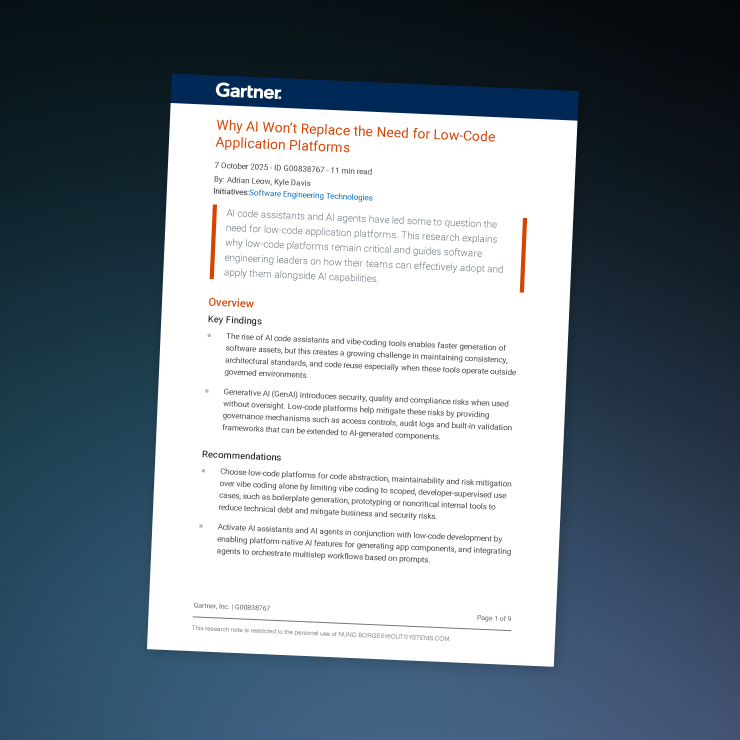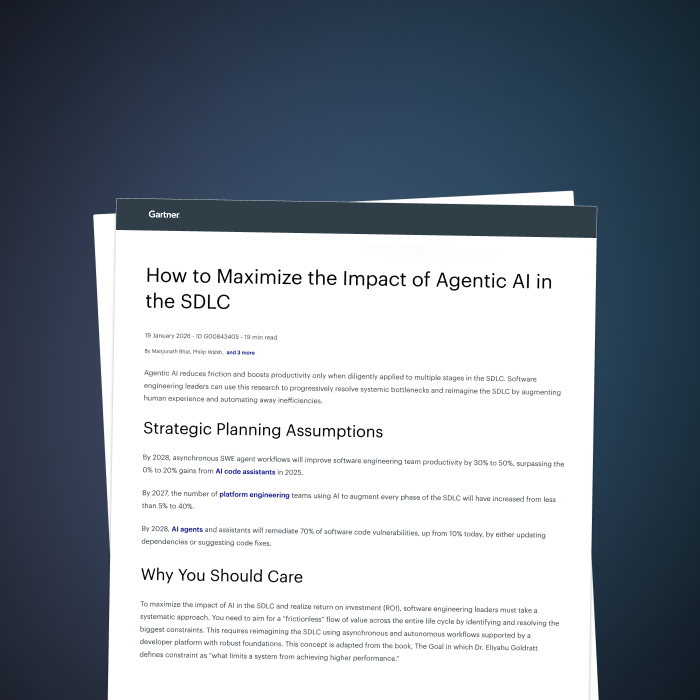
AI-assisted development encompasses a set of tools and techniques that leverage artificial intelligence and machine learning algorithms to revolutionize the way software is created. In this article, we'll delve into the definition of AI-assisted development, look at examples of the technology, and explain the numerous benefits it provides to developers and organizations.
Learn how agentic AI empowers teams to delegate outcomes.
https://www.outsystems.com/ai/what-is-agentic-ai
Discover what AI agents are and their importance for enterprises.
https://www.outsystems.com/ai/what-are-ai-agents
Learn the definition of AI agent orchestration and how it works.
https://www.outsystems.com/ai/agents-orchestration
In this guide, explore AI security threats, risks, and best practices.
https://www.outsystems.com/ai/what-is-ai-security
How autonomous AI delivers end-to-end outcomes with reasoning and planning.
https://www.outsystems.com/ai/autonomous-ai
Your next “hire” might be a digital worker. Learn more about this AI-powered assistant.
https://www.outsystems.com/ai/what-is-digital-worker
How modern app development supports enterprise systems.
https://www.outsystems.com/application-development
The basics of low-code technology for enterprise delivery.
https://www.outsystems.com/low-code
A complete guide for digital transformation frameworks.
https://www.outsystems.com/digital-transformation
The growing role of AI and agentic systems in software development.
https://www.outsystems.com/ai/ai-software-development
Does AI-assisted development improve developer productivity?
Artificial intelligence enhances dev productivity by automating repetitive tasks, offering intelligent recommendations and contextual guidance, and reducing debugging and testing time.
Does machine learning have an impact on predictive analytics?
What is the difference between AI, generative AI, and machine learning?
How does AI automate the software development process?
By automating repetitive tasks, suggesting the next steps in the development process, and provisioning feedback on failed tests, AI enables developers to work more efficiently.
What are machine learning models?
ML models are functions or formulas that take input data (features) and produce outputs (predictions) based on the patterns learned from training data.
Can AI replace human intelligence?
Artificial intelligence can complement and enhance human intelligence in many tasks, but it's unlikely to replace human intelligence fully.


AI-assisted development uses machine learning (ML) models developed from millions of anonymized code patterns to recommend the correct tools and patterns for any developer situation to the developer. It’s designed to increase focus and productivity by helping users create logic flows faster and with more confidence, even for complex tasks.
There are two main benefits to AI-assisted development:
Essentially, a virtual expert fills the role of a tech lead, providing guidance, doing some of the more common tasks, conducting the code review, and validating the quality of the software. How AI assists in the development process throughout the software development lifecycle (SDLC) can be divided into three main buckets.
AI-assisted development automates common operations that are repetitive and time-consuming, including testing. Machine learning (ML) models based on millions of anonymized patterns can suggest and even choose the next best steps in development. If an application fails a test, AI can also provide feedback to the developer about the areas that need to be remedied. As a result, developers are more productive and engaged, and novices benefit from the lessons learned from similar programming.
AI-assisted development includes discovery tools that analyze application dependencies, identifying violations and “red flagging” the elements (actions, screens, entities) that are assembled in the wrong place. They enforce best practices and identify duplicate code while enabling teams to keep pace with accelerated production schedules.
During the application development process, developers sometimes get stuck. AI-assisted development helps them find what they are looking for and get them back on track sooner. For instance, contextualized search experience accessed from the development environment can bring up online resources that might help to complete the task they are undertaking. And next-step suggestions walk developers through logic flows.
Examples of AI-assisted development include:
Elite DevOps performers are pushing out clean code into production environments multiple times a day. There is no way that this velocity can be maintained – let alone improved upon – without the automation provided by AI.
The latest State of Application Development report shows that 31% of organizations consider AI-assisted development an integral component of their software development practices. At OutSystems, our vision for the future of AI-powered development includes:
By adding AI to all stages of the development process, the OutSystems AI-powered low-code platform helps development teams maximize their existing capabilities, freeing them to focus on the software that truly makes the difference, instead of wasting their time on just keeping the lights on.
"Gen AI was the masterpiece behind my strategy to help solve the business problem of scaling and automating our support operations. Using our own platform, we were able to deliver a generative AI chat agent and make an immediate impact."