Legacy modernization for the agentic era
Your legacy estate has quietly become the bottleneck between AI investment and AI return. With OutSystems, you get a governed, step-by-step path away from unsupported systems and onto a modern core. Keep your business rules intact, own and audit your code, and avoid a multiyear rewrite. Stop paying for legacy tech that barely works.

Understand what you're working with before you begin
Migration and modernization projects stall when teams don't fully understand what the legacy system does. Get that answer first, on the applications that matter most, and turn a multi-year gamble into a sequence of decisions you control.

Rank the portfolio by business value and complexity, so you modernize what matters first.
Agents read the legacy source and generate human-readable specifications of what the system actually does.
Your architects validate and correct the specification before anything gets built.



Move to a modern platform where you own what runs
This is where the exposure ends: legacy systems are retired, along with the compliance risks they created. OutSystems experts or a certified partner handle the work.
Rebuild from the validated specification, with your team in control at every step.
Run standard, compiled cloud-native code you can read, audit, and keep.
Migrate incrementally, retiring legacy systems as each application proves out.



Redesign the work around agents, grounded in your own logic
The Enterprise Context Graph grounds agents in your real architecture and logic. That’s what lets you redesign how the work gets done, with agents handling the repetitive tasks and your people owning the decisions.
Add agents to workflows your legacy systems could never support.
Ground every agent in your enterprise context, so it acts safely on your live system.
Govern every agent with the audit trail, data lineage, and access controls.



Other AI initiatives
What else are you trying to do? (We can help.)

Agentic Orchestration


Agentic Engineering
Legacy Modernization FAQ
You can modernize incrementally using a phased approach. OutSystems avoids risky rewrites by letting you isolate legacy logic, migrate applications in waves, and maintain connections to your existing systems while modernizing. Organizations like Gen Re successfully used this multi-phase approach to deploy 30 applications over nine months.
Modernization timelines depend on scope. OutSystems helps teams consolidate their modernization timeline to weeks or months rather than years. OutSystems offers a 3-week workshop to assess, document, and build a proof-of-concept application. Real-world deployments include TravelEssence rebuilding an aging core system in four months and Estafeta rebuilding its CRM in 24 weeks.
Your core business logic and data are preserved and re-architected into modern, cloud-native applications. AI parser agents read the legacy source code to generate human-readable requirements blueprints. Your architects then review and validate these specifications, ensuring intellectual property is captured and transferred to a governed OutSystems environment.
Yes, OutSystems seamlessly connects to existing legacy backends and databases during migration. You can build a modern "digital skin" or mobile/web frontends using APIs and standard connectors to read and write data to existing mainframes, SAP, or AS/400 systems, keeping daily operations running uninterrupted while incrementally replacing core systems.
Data migration and schema mapping are executed as structured activities within professional services or certified partner engagements. The platform connects to legacy relational databases (Oracle, SQL Server, DB2) to preserve data integrity, maintain security controls, and establish clear data lineage and audit trails on a governed architecture.
OutSystems uses a "migrate then modernize" approach that avoids both risky multi-year rewrites and lift-and-shift "code-and-load" traps. The platform reverse-engineers legacy logic into documented specifications, scaffolds a modern baseline application, and allows you to incrementally refactor or extend functionality without losing custom business differentiators.
Yes, existing business rules and workflows are fully preserved and documented. AI parser tools automatically extract undocumented logic trapped inside legacy code. Your software architects validate and refine these rules in a human-readable blueprint before generating the application, keeping your competitive advantages intact.
Modernization is guided by OutSystems experts or certified partners alongside your internal team. Existing legacy developers (including Lotus Notes or COBOL specialists) do not need to be replaced; they are easily retrained on the platform to supply critical domain knowledge while architects retain final decision-making oversight.
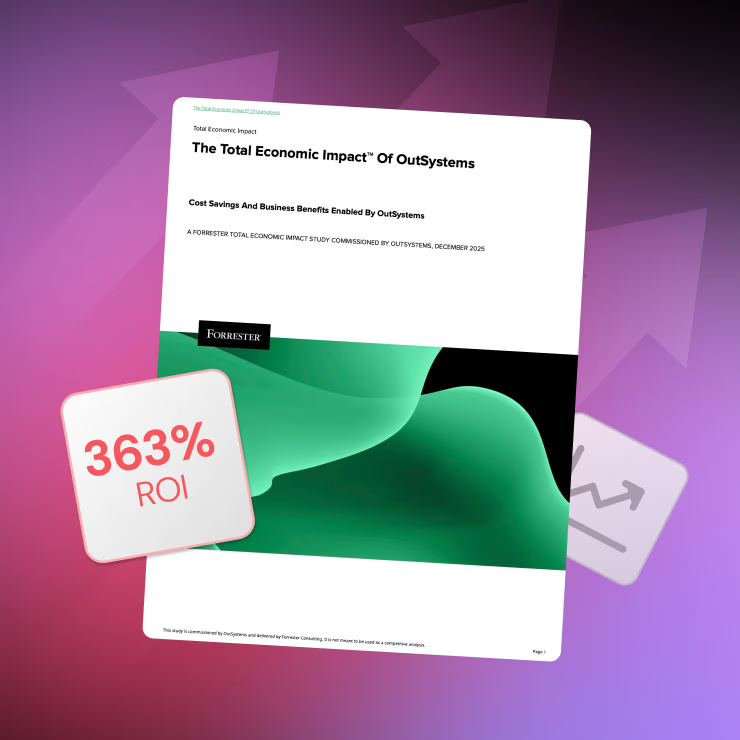
Legacy modernization cost will vary depending on scope. According to the Forrester TEI study, OutSystems customers avoid $2.8M in costs by retiring legacy systems and can achieve 363% ROI. They also show 60% faster development and 80% decrease in developer ramp-up.