
Digital transformation: What it is, why it matters, and how enterprises succeed
Digital transformation is a strategic imperative for staying competitive in a market where customer expectations shift quickly, technology cycles keep shortening, and operational resilience is no longer optional. At the enterprise level, it’s not a “tech project.” It’s a coordinated effort to improve how your organization delivers value through better experiences, smarter operations, and modernized ways of working.

What is digital transformation?
Digital transformation is the enterprise-wide evolution of how an organization delivers value using modern technologies, data, and operating models. It typically includes three connected dimensions:
- Technology modernization: Updating platforms, architectures, and tooling so teams can build, integrate, secure, and scale products faster.
- Process and operational change: Redesigning workflows, automation, governance, and decision-making so work moves efficiently across the organization.
- People and culture shifts: Enabling new ways of working—cross-functional collaboration, product thinking, experimentation, and continuous improvement.
Digital transformation is not just adopting new tools. It’s aligning people, processes, and technology to create measurable business impact.
That alignment typically shows up in three key areas:
Customer experiences
Customer experience transformation goes beyond launching a new app or redesigning a website. It’s about creating consistent, connected interactions across channels—web, mobile, in-person, support, and partner ecosystems. Enterprises focus on reducing friction in journeys like onboarding, purchasing, claims, servicing, renewals, and self-service while personalizing experiences with better data and faster feedback loops.
Operational processes
Operational transformation improves how work gets done across finance, HR, supply chain, customer operations, field service, and IT. That often means simplifying workflows, automating repetitive tasks, integrating systems that don’t talk to each other, and improving visibility with dashboards and observability. The goal is higher throughput with less waste: faster cycle times, fewer errors, and more resilience when conditions change.
Business models
Digital transformation can also reshape how value is delivered and monetized. That might mean expanding from product sales into subscription services, enabling new partner channels, launching data-driven offerings, or creating new digital experiences that increase retention. For many enterprises, the biggest shift is moving from “projects” to continuously evolving digital products backed by modern platforms and operating models.
Digital transformation vs digitization vs digitalization
These terms are often used interchangeably, but they’re not the same:
- Digitization is converting analog information into digital form, like scanning paper invoices into PDFs.
- Digitalization is using digital tools to improve an existing process, such as moving invoice approvals into an online workflow with automated routing.
- Digital transformation is a broader shift in how the business operates and competes, enabled by modern tech, data, and new ways of working. For instance, redesigning the procure-to-pay process end-to-end by integrating ERP and suppliers, automating approvals, improving spend analytics, and changing accountability so teams can continuously optimize.
What is driving digital transformation today?
In 2026 and beyond, digital transformation is being driven by a combination of market forces, technology shifts, and internal pressures that compound over time.
Rising customer expectations and competitive pressure
Customers increasingly compare your experience to the best experience they’ve had anywhere—not just within your industry. That raises the baseline for speed, personalization, transparency, and self-service. Digitally native competitors also move quickly because their systems, operating models, and teams are built for continuous change.
Cloud, data, and AI acceleration
Cloud platforms and modern data capabilities make it possible to scale faster, integrate more systems, and experiment with new experiences without being blocked by infrastructure constraints. AI is accelerating this further by improving automation, decision-making, and personalization—while also raising the bar on governance, risk, and security.
Efficiency, cost control, and resilience
Many enterprises are being asked to do more with less: reduce backlog, modernize legacy systems, and improve productivity without increasing headcount. Resilience also matters more, whether the disruption is regulatory change, supply chain volatility, cybersecurity threats, or market shifts.
Regulatory, privacy, and security realities
As systems become more connected and data becomes more central, governance and security become transformation drivers—not just constraints. Leaders need stronger visibility into risk, clearer accountability, and modern controls that support innovation rather than slowing it down.
A practical implication of these drivers is that enterprises need architectures and delivery approaches designed for change. For teams modernizing their development model, cloud-native patterns can be a major enabler. To explore that in more depth, see our guide on cloud-native application development.
What is a digital transformation strategy—and why is it necessary?
A digital transformation strategy is a coordinated plan that defines how an organization will modernize technology, redesign operations, and enable new ways of working to achieve business goals. It’s different from isolated initiatives—like migrating one system to the cloud, launching a mobile app, or automating a single workflow. Those initiatives can be valuable, but without an aligned strategy, they often create fragmentation: inconsistent experiences, duplicated effort, mismatched priorities, and technology sprawl.
The stakes are clearly rising, too. IDC forecasts worldwide spending on digital transformation will reach almost $4 trillion by 2027, reflecting how central this has become to enterprise competitiveness. However, execution is uneven. Gartner reports that only 48% of digital initiatives meet or exceed their business outcome targets on average, which is exactly why strategy and governance matter as much as technology.
A strong strategy typically clarifies:
- The “why” and desired outcomes: What will change for customers, employees, and the business? What does success look like?
- A transformation roadmap: Which capabilities are built first, and what must be modernized to enable them?
- Operating model and governance: Who owns what, how decisions are made, how risk is managed, and how teams collaborate.
- Technology and platform choices: How the enterprise will build, integrate, secure, and scale digital solutions.
- Talent and execution approach: Skills, team structure, delivery methodology, and change management.
- Measurement: Clear metrics tied to value: speed, quality, cost, adoption, and business performance.
Without this strategy, enterprises risk moving fast in the wrong direction—investing heavily but failing to create durable capabilities. That durability is crucial because organizations that optimize purely for short-term efficiency can end up with brittle systems that don’t hold up under volatility, which is why transformation strategy needs to bake in resilience and adaptability from the start. And customer expectations can shift faster than planning cycles: McKinsey noted that digital adoption vaulted roughly five years in about eight weeks during the pandemic, a reminder that transformation can’t be treated as a one-and-done program.
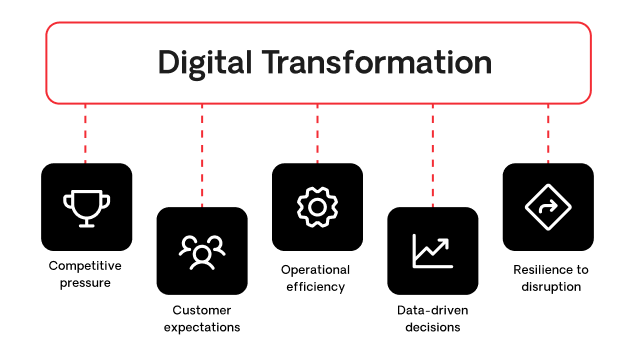
Why a digital transformation strategy matters
Competitive pressure
A coordinated strategy helps enterprises innovate faster and respond to changing markets without reinventing the wheel each time. It supports repeatable delivery, so teams can launch, learn, and improve continuously.
Customer expectations
Strategy brings consistency to cross-channel journeys. Instead of improving one touchpoint in isolation, enterprises can redesign an end-to-end experience and ensure the supporting systems and processes evolve with it.
Operational efficiency
Modern workflows, integrated systems, and automation reduce friction and rework. That translates into faster throughput, fewer errors, and more capacity to focus on higher-value work.
Data-driven decisions
A strategy prioritizes data foundations, allowing leaders to access reliable insights, measure outcomes, and make decisions based on what’s actually happening across the business.
Resilience to disruption
Enterprises with modern platforms and delivery practices are less vulnerable to disruption because they can adapt quickly—whether the pressure comes from regulation, cybersecurity, supply chain volatility, or changing customer behavior.
Core digital transformation technologies
Digital transformation is enabled by a set of foundational technologies that support speed, scale, and continuous improvement. Most enterprises invest across several categories at once for maximum efficiency.
Cloud platforms and modern architectures
Cloud enables elastic scaling, faster provisioning, and modernization patterns that support continuous delivery. This includes cloud-native architectures, containerization, and modular approaches that reduce coupling between systems.
Data platforms and analytics
Transformation depends on turning data into usable insight across customer behavior, operational performance, risk, and forecasting. Modern data platforms unify data sources, improve accessibility, and make it easier to operationalize analytics into day-to-day decisions. For organizations focused on connecting data across systems and experiences, a data fabric approach can help reduce fragmentation and increase visibility.
AI and machine learning
AI supports personalization, forecasting, anomaly detection, customer support, and process optimization. It also supports new internal capabilities, like generating content, summarizing information, accelerating development tasks, and improving knowledge access.
Automation and workflow orchestration
Automation reduces manual effort and improves consistency, but the biggest impact typically comes from connecting automation to end-to-end workflows. That requires orchestration, integration, and governance. Workflow automation can help enterprises standardize processes while still enabling flexibility across teams and business units.
Integration and APIs
Enterprises rarely transform by replacing everything at once. Integration—APIs, connectors, event-driven patterns, and middleware—is what allows new digital solutions to coexist with core systems and legacy infrastructure while modernization happens in phases.
Security, identity, and governance
Security and compliance aren’t add-ons. Modern identity management, secure-by-design patterns, and governance frameworks make it possible to move fast without creating unacceptable risk—especially as AI and data use expand.
How is AI fueling digital transformation technologies?
AI is a core accelerator of digital transformation because it improves both speed and intelligence across the enterprise. It’s not limited to a single function or department either. Its impact spans customer experience, operations, analytics, and decision-making, while also unlocking efficiencies and enabling new forms of innovation.
Customer experiences
AI supports personalization, smarter search, conversational interfaces, and faster issue resolution through chat and agent-assist. The practical upside is scale: teams can handle higher volumes, reduce friction in self-service, and deliver more consistent experiences across channels.
Operations
AI can optimize workflows, detect anomalies, reduce manual triage, and improve forecasting. This is especially valuable in complex environments where teams manage constant exceptions and approvals. AI can streamline the messy middle of work so people spend less time sorting and more time executing.
Data and decision-making
AI can surface patterns that are difficult to detect manually, improve predictive models, and accelerate analysis across large datasets. That helps leaders and teams move from reactive reporting to proactive decisions embedded directly into day-to-day workflows.
OutSystems’ AI-powered platform helps teams embed AI into digital experiences and automation in a way that supports enterprise delivery at scale. Mentor, our AI app generation capability, reduces time spent on repetitive build work and helps teams translate ideas into working software faster. And as organizations explore more autonomous patterns, Agentic AI Workbench supports designing and governing AI agents so they can be orchestrated responsibly within broader transformation programs.
Enterprises are learning that AI success depends on fundamentals: data quality, governance, security, and clear ownership. The strongest results tend to come from targeted, high-value use cases that are designed into real workflows—not experiments that remain disconnected from daily operations.
Common digital transformation challenges
Digital transformation delivers meaningful benefits, but enterprise execution is hard. Many efforts stall because they underestimate complexity, over-focus on tools, or fail to align the operating model to the strategy. Common challenges include:
Legacy systems and technical debt
Older systems can slow progress because they’re expensive to change, difficult to integrate, and risky to extend. Even when legacy modernization starts, it can be blocked by dependencies, unclear ownership, or lack of documentation. A practical approach is phased modernization: modernize interfaces first, integrate where needed, and rebuild or replace strategically based on business value.
Resistance to change
Transformation often changes roles, workflows, and accountability. Even strong technology outcomes can fail if teams don’t adopt the new ways of working. Leaders need clear communication, enablement, and visible sponsorship, alongside practical training that helps teams succeed in the new model.
Talent shortages and capacity limits
Enterprises frequently face constraints in engineering capacity, architecture skills, data expertise, and security resources. If transformation relies only on scarce specialists, progress slows. Successful programs broaden delivery capacity with reusable patterns, shared platforms, and tools that increase productivity across teams.
Organizational silos
Silos cause misalignment: business and IT teams optimize locally rather than solving end-to-end problems. Transformation requires shared priorities, cross-functional teams, and governance that encourages collaboration without creating bureaucracy.
Cost of implementation and unclear ROI
Transformation investment can feel daunting, especially when benefits appear later. Clear prioritization and measurement help. Enterprises that tie initiatives to outcomes—reduced cycle time, higher adoption, lower support volume, fewer errors, improved retention—can show progress earlier and sustain momentum.
Fragmented initiatives
When different teams launch disconnected digital projects, the result is inconsistent experiences, duplicated tooling, and rising complexity. A transformation strategy and shared platform reduce this fragmentation by standardizing the how, while allowing teams flexibility in the what.
Core pillars of digital transformation
Enterprises succeed when digital transformation is managed as a holistic program rather than a set of disconnected initiatives. A practical framework includes five pillars:
- Customer value and experience: Transformation should map directly to customer needs and end-to-end journeys, not internal org charts. Prioritize the moments that matter—onboarding, purchasing, servicing, support, and renewal—and build feedback loops that continuously improve those experiences.
- Operational excellence: Modernizing operations means redesigning workflows, reducing handoffs, and automating where it improves speed and quality. This pillar often delivers early wins because it reduces friction that teams feel daily.
- Data and intelligence: Data should be accessible, trustworthy, and usable across teams. This pillar includes analytics, governance, and the ability to operationalize insights into workflows and decisions.
- Technology foundation and scalability: A modern foundation supports continuous change: secure architectures, integration, APIs, automation, and platforms that scale across teams and use cases. This is where modernization moves from one-off projects to repeatable capability.
- People, operating model, and governance: This pillar is what makes progress sustainable. It includes roles and skills, how teams collaborate, how decisions get made, how risk is managed, and how the organization supports continuous delivery instead of periodic “big launches.”
When these pillars reinforce each other, transformation becomes less fragile. Teams can move faster because they’re building on stable foundations with clear ownership and measurable outcomes.
Platforms for digital transformation: The role of low-code
Low-code technology can help enterprises accelerate transformation by increasing delivery speed, reducing complexity, and scaling development capacity. For transformation programs, the value is not just “building faster.” It’s enabling repeatable, enterprise-grade delivery across multiple initiatives.
Deploy applications faster
Accelerate the build-test-release cycle so teams can deliver value sooner, iterate quickly, and respond to changing requirements without dragging timelines. Western Union is a strong example: it launched new digital banking services in two countries in just 11 months and delivered 20+ apps while modernizing its broader digital ecosystem.
Enable collaboration across teams
Support collaboration between IT and the business with shared visibility and faster feedback loops. This is especially important for workflows that span departments and require rapid iteration.
Adapt to new business needs
Transformation priorities change as markets change. Low-code supports agility by making it easier to evolve applications and workflows without starting over.
Integrate legacy systems and modern technologies
Transformation rarely starts with a clean slate. Enterprises need tools that work across legacy systems, new cloud services, and data platforms—without forcing a risky “rip and replace.”
Reduce development and maintenance costs
Standardized components, reusable patterns, and productivity gains can lower total cost over time, especially when the platform supports governance and lifecycle management. Oceaneering is a prime example: it built an inventory management system in four months to manage more than $60 million in offshore spare parts, improving accuracy and reducing costly downtime tied to missing or mismanaged inventory.
Learn more about how Oceaneering modernized inventory management to reduce downtime
Low-code tech also aligns closely with AI adoption and modern architectures. As enterprises adopt AI for automation and decision support, the ability to quickly build, integrate, and operationalize AI capabilities inside real workflows becomes a competitive advantage.
OutSystems as a digital transformation platform for enterprises
Digital transformation involves multiple stakeholder groups—each with different goals, constraints, and definitions of success. OutSystems supports enterprise transformation by helping teams modernize legacy systems, deliver new digital experiences faster, and operationalize strategy through scalable, governed application delivery.
For IT leaders
- Holistic change: Enable enterprise agility by modernizing the application landscape, connecting systems through integration, and reducing fragmentation across teams and tools.
- Future-ready foundations: Support modernization with capabilities that evolve as technology shifts, helping the organization keep pace without constant reinvention.
For IT pros
- Backlog reduction: Accelerate delivery timelines and reduce bottlenecks so IT can meet business demand more reliably.
- Collaboration: Improve cross-functional collaboration through shared processes, standardized patterns, and better visibility into work.
- Integration: Ensure new solutions connect cleanly with existing systems, reducing the operational burden of fragmented architectures.
- Governance and compliance: Support enterprise standards using security controls and lifecycle management, so teams can move fast without losing control.
- Modernization: Use flexible approaches to update or replace legacy systems in phases, balancing speed with risk management.
For developers
- Efficiency and acceleration: Use reusable components and templates to reduce repetitive work and improve time-to-market without compromising quality.
- Customization: Build tailored solutions that match business requirements while maintaining consistency with platform standards.
- Support across the lifecycle: Enable testing, monitoring, and performance improvements as part of continuous delivery rather than last-minute remediation.
For line-of-business leaders
- Business outcomes: Deliver applications and workflows aligned to measurable outcomes—revenue growth, cost savings, improved service, and stronger customer retention.
- Ease of adoption: Reduce training and enablement challenges with intuitive experiences and faster iteration based on real user feedback.
See how leading organizations are driving innovation with digital transformation strategies
HEINEKEN’s success: A digital transformation case study
HEINEKEN made AI apps and agents part of its EverGreen strategy—an enterprise-wide effort focused on customer centricity, productivity, and urgent business digitalization. A major objective of that strategy was to give back one million hours to the business by improving processes and increasing automation.
Rather than approaching transformation as a one-time program, HEINEKEN treated it as a scalable model for continuous delivery. That meant enabling teams to build and evolve digital experiences more efficiently, while maintaining the governance needed in a global organization.
The results reflect the practical value of transformation done well: time returned to the business, more tailored digital experiences, and broader automation and efficiency across operations.

“The EverGreen strategy translates into becoming the best-connected brewer. This strategy comprises several elements, one of them being the use of hyperautomation to support our productivity and digitalization ambitions."
Enterprise use cases for digital transformation platforms
Digital transformation platforms support a wide range of enterprise use cases, often spanning multiple departments and systems. Common examples include:
- Banking: Customer onboarding, account servicing, fraud workflows, case management, and modernization of internal tools that support speed and compliance.
- Healthcare: Patient portals, scheduling, care coordination workflows, operational dashboards, and integration across clinical and administrative systems.
- Insurance: Claims intake and servicing, underwriting support, policy servicing, customer self-service portals, and modernization of core workflows that require governance.
- Government: Resident service portals, permitting, case management, benefits administration, and digital experiences designed for accessibility and scale.
- Manufacturing: Supply chain visibility, field service enablement, asset management, quality workflows, and modernization of systems used on the plant floor or in distribution.
- Retail: Omnichannel experiences, loyalty journeys, inventory visibility, returns workflows, and operational tools that support faster execution.
Accelerating digital transformation
Digital transformation is not a finish line. It’s continuous, enterprise-wide improvement, enabled by strategy, the right technologies, and platforms that scale across teams and use cases. The strongest programs connect business priorities to execution, modernize in phases, and build a foundation that supports ongoing innovation across customer experience, operations, and IT.
OutSystems helps enterprises operationalize transformation by accelerating modernization, reducing delivery bottlenecks, and enabling governed innovation at scale. With a platform approach, teams can move faster without sacrificing security, compliance, or maintainability.
Are you ready to modernize your business? Schedule a demo with OutSystems today to experience the AI development platform designed to accelerate your digital transformation.
Useful resources


Related resources

Learn the fundamentals of modern development


Frequently asked questions
Yes, low-code platforms like OutSystems excel at modernizing legacy systems. They can provide modernized user interfaces, extend existing functionality, or completely refactor or rebuild outdated systems, all while maintaining integration with critical legacy infrastructure.
Most internal workflows can be digitized and automated within weeks. Low-code technology uses pre-built components and visual tools to streamline the design, development, and deployment processes, ensuring rapid results.
While frameworks vary, strong enterprise programs typically include pillars that cover customer value and experience, operational excellence, data and intelligence, a scalable technology foundation, and the people/operating model needed to sustain change.
Yes. Low-code technology can integrate with existing applications through APIs or pre-built connectors, enabling you to add new features, improve interfaces, or extend functionality without disrupting core systems.
Examples include redesigning customer onboarding across channels, modernizing claims or servicing workflows end-to-end, building self-service portals connected to core systems, automating internal operations with orchestration, and using data and AI to improve decision-making in real workflows.