

Gartner® report: Emerging Tech Impact Radar: Generative AI
Strategic insights on closing the GenAI value gap, mastering Agentic AI, and orchestrating enterprise-grade model networks.
Navigating the generative AI validation hurdle
Generative AI is facing a critical validation hurdle: despite surging enterprise investment, real-world returns frequently lag behind expectations. With less than 10% of agentic implementations currently capturing strong ROI, tech leaders must move past the hype and prioritize technologies that deliver proven business outcomes.
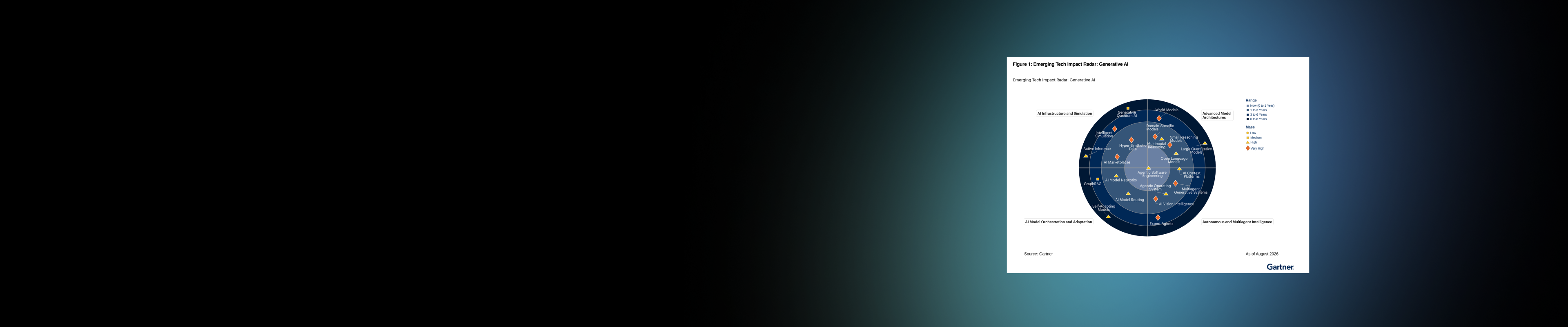
This Gartner® report uses the Impact Radar framework to map 21 emerging generative AI technologies and trends across four critical themes:
- Advanced Model Architectures: Leveraging Small Reasoning Models (SRMs), Open Language Models, and Domain-Specific Models (DSMs) for targeted efficiency.
- Autonomous & Multiagent Intelligence: Harnessing Expert Agents, Multiagent Generative Systems (MAGS), and Agentic Software Engineering.
- AI Model Orchestration: Implementing Model Routing and AI Model Networks to optimize performance, cost, and risk.
- AI Infrastructure & Simulation: Scaling Active Inference, World Models, and AI Context Platforms.
Our Key takeaways for business and IT leaders
Uncover the key technologies and trends that will define how AI is used across your business. As you read this report, we recommend you consider our following key takeaways:
- Bridge the agentic value gap: Technology innovation is outpacing enterprise deployment capacity. Ground breakthrough agentic systems with enabling technologies like AI Context Platforms and Agentic Operating Systems to establish trust, governance, and operational scale.
- Escape the single model trap: Relying on a single AI model is unsustainable. Deploying Model Routing and modular AI Model Networks lets you dynamically match tasks to the most cost-efficient model—where small models under 10B parameters can be over 1,000x more cost-efficient than frontier models.
- Modernize the SDLC with agentic software engineering: Move beyond simple code generation. Integrate autonomous agents across planning, design, refactoring, and security validation to eliminate SDLC bottlenecks and achieve full-lifecycle speed.
Gartner, Emerging Tech Impact Radar: Generative AI, Annette Zimmermann, Danielle Casey, 7 August 2026. Gartner is a trademark of Gartner, Inc. and/or its affiliates.
Frequently Asked Questions
OutSystems provides an enterprise agentic systems platform that combines rapid development agility with governed AI capabilities. Powered by Enterprise Code Generation (ECG), it works alongside tools like OutSystems Mentor and Agent Workbench to help teams safely build, orchestrate, and deploy Agentic systems.
OutSystems Mentor serves as a conversational Generative AI assistant across the entire software development lifecycle. Developers use natural language prompts to generate functioning application logic, data structures, and user interfaces. Powered by the Enterprise Context Graph (ECG), Mentor automatically analyzes code, recommends updates, and enforces enterprise security guardrails before deployment.
Yes. OutSystems supports an open development ecosystem through Agentic Systems Engineering. Powered by the Enterprise Context Graph (ECG), developers can use external Generative AI coding tools like Claude Code or Cursor alongside OutSystems Mentor.