
Power smarter apps and agents with OutSystems Data Fabric
OutSystems Data Fabric unifies structured and unstructured data across your enterprise into a single virtual layer. By giving AI agents and applications seamless access to complete, real-time context, it helps drive faster, more informed decisions—across every workflow and use case.







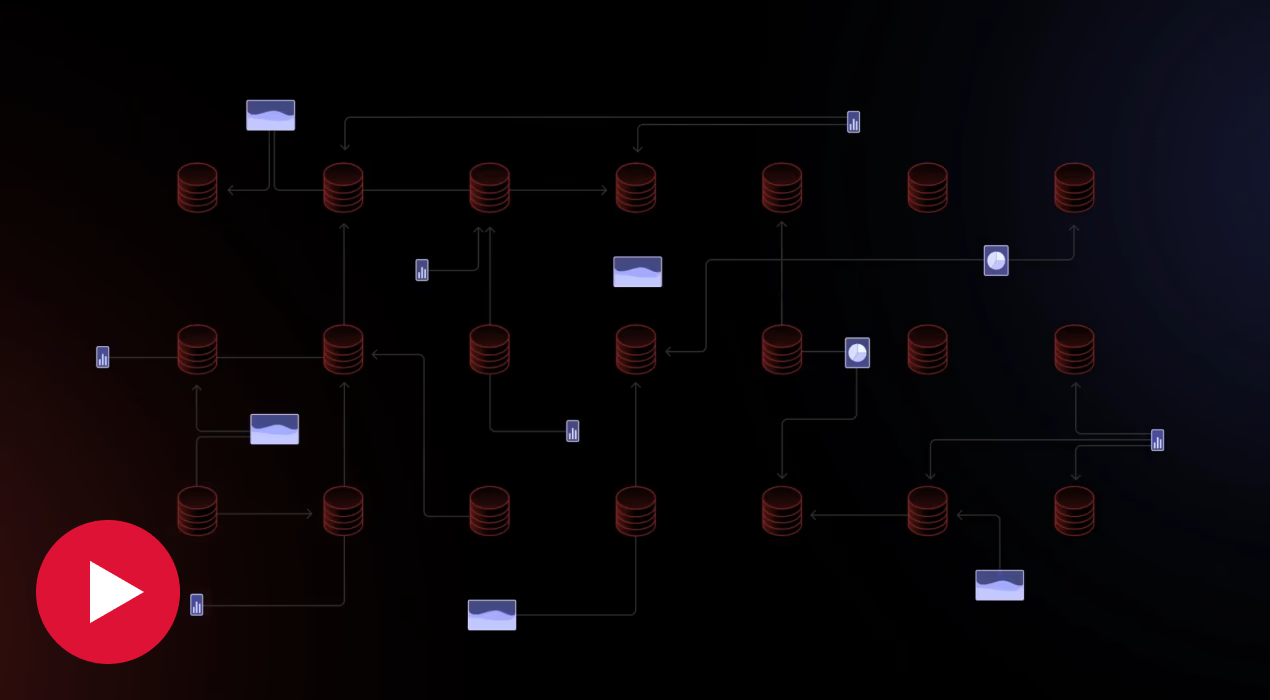
Centralize access to all your data
Pre-built connectors make it easy to link external databases or systems—while enabling reusability for future app dev needs.

Fuel smarter agents, your way
Give AI agents full context—structured or unstructured, from any source—with OutSystems Data Fabric. Empower them to reason, respond, and deliver impact across your business.


"OutSystems gives us more speed and agility, and the flexibility to build mobile apps, make rapid changes, and integrate with any system we need to."

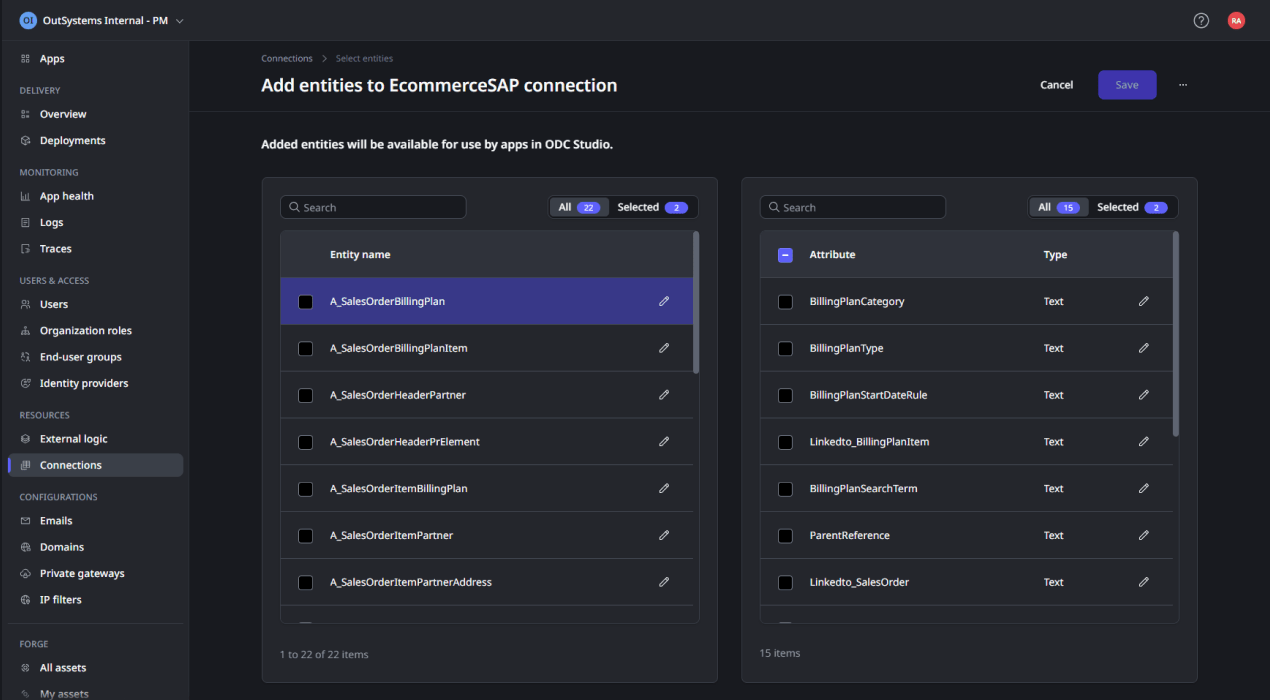
Say goodbye to data complexity
Data, data everywhere? No more. With the effortless data discovery and retrieval enabled by OutSystems Data Fabric, any data is ready for any app, anytime.
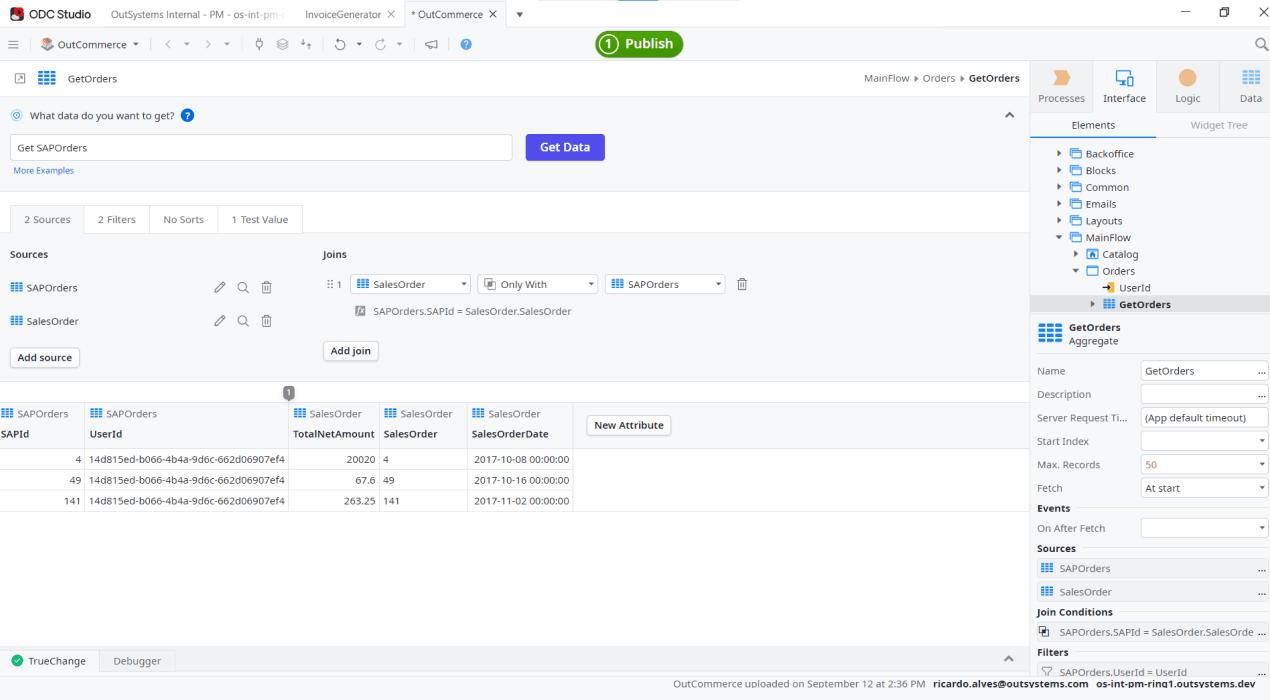
Scale your apps with ease
No data volume fears here. Built-in caching guarantees a great experience for all your data-based apps—regardless of data storage location.
Own your data exposure
Get full control over data exposure thanks to granular access controls that give you robust security, privacy, and governance—and peace of mind.
Data Fabric
FAQ
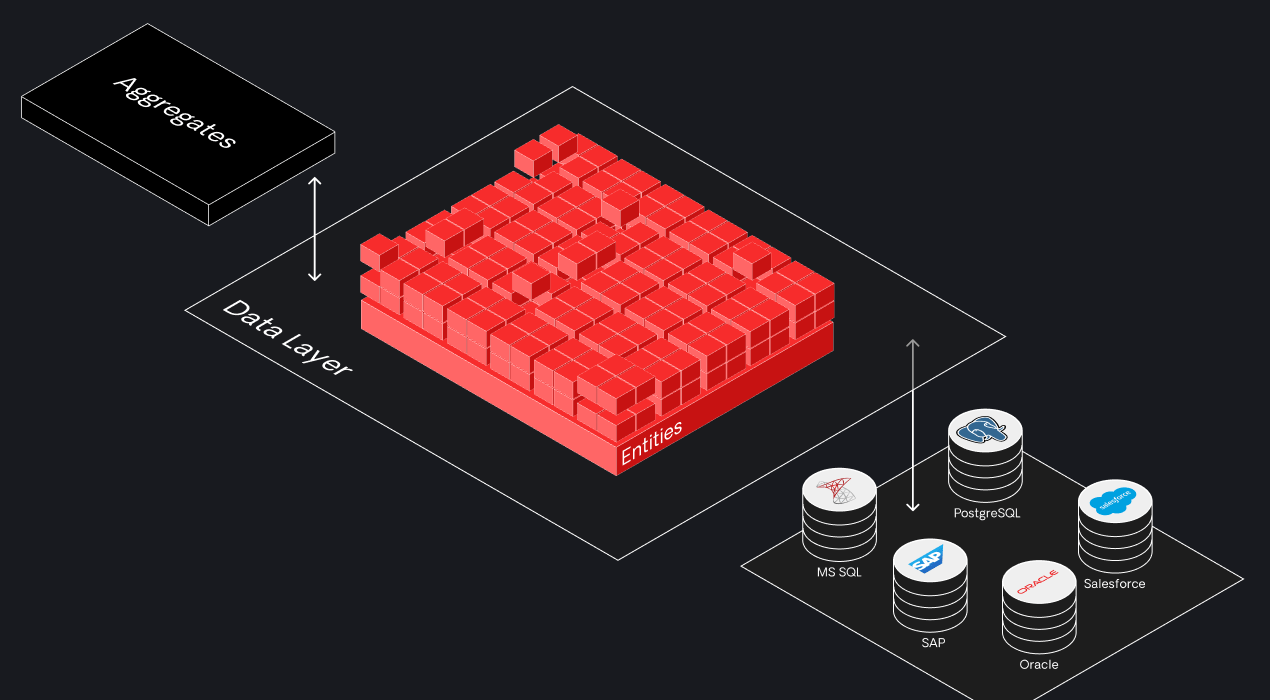
The virtualization layer ensures uniform data representation, simplifying handling. Regardless of source format, data is mapped into entities and attributes for consistent use. This streamlines manipulation, allowing standard constructs like aggregates and lists across all sources.
Centralizing data in one repository streamlines discovery and retrieval. The platform promotes reusability via custom datasets, tailored for teams with different permissions. It provides a unified view, displaying accessible data sources based on roles, easing data access for diverse teams and IT managers.
As long as there are no significant changes in the external system, such as deleting entities or altering login credentials, our system maintains connectivity without issue. We securely store all relevant connection details, ensuring seamless access for an extended period.
It's the ability to tailor datasets for specific lines of business requirements, integrating data from various sources. For example a tailored 360-degree app for a sales team. With custom datasets, data from Salesforce, SAP, or other sources can be easily combined, all set for reuse in a given sales application.
It functions as a data gateway that standardizes data from various sources, providing access to the application layer during development. When data is requested, it passes through the platform, undergoes transformation, and becomes accessible to the application during both development and runtime.
OutSystems Data Fabric gives teams a practical answer to why data integration matters in enterprise development. It creates an advanced virtual data layer that unifies data from disparate sources like SAP, Salesforce, external databases, legacy systems, and SaaS applications, so you can reduce data silos, avoid manual data mapping, and build data-driven applications faster with built-in security, governance, and strong performance.
To understand what is Data Fabric, think of it as a data layer that sits above multiple systems and sources to unify data from disparate environments while abstracting the complexity underneath. It creates a single, consistent view of data across silos, making it easier to access, incorporate into applications, and adapt as business needs and technologies change.
Knowing when to use OutSystems Data Fabric comes down to complexity. OutSystems Data Fabric is a strong fit when an application needs data from multiple systems and you want to avoid heavy API orchestration, manual joins, or ongoing synchronization work. It is especially useful for building a 360-degree customer view, supporting legacy modernization, establishing master data management, and powering sales or e-commerce applications with unified, reusable, and governed data.
OutSystems Data Fabric connects to common enterprise data sources, including databases, APIs, cloud platforms, and business systems such as SQL Server, Oracle, PostgreSQL, SAP, Salesforce, Snowflake, and others. It helps teams access existing data without rebuilding custom integration for every source, supporting faster app development across complex technology environments.
With OutSystems Data Fabric, your data stays in its original source system. Data Fabric leverages a virtualization layer that maps to your existing database, application, or enterprise system instead of relocating the data. This helps support data residency, sovereignty, compliance, and cost-control requirements.
No. OutSystems Data Fabric does not copy or move your data by default. It creates a live map to the original data source, so applications can access current information without duplicating records into OutSystems. This reduces storage overhead and helps regulated organizations maintain control over sensitive data.
Data Fabric helps connect O11 and ODC through secure connectivity, allowing customers to expose O11 data to ODC. This supports a phased modernization path, so teams can use ODC capabilities, including AI agents, without immediately migrating or rebuilding existing O11 applications.
OutSystems Data Fabric can support real-time or near real-time data access depending on the use case. Operational applications may require live access to source systems, while other scenarios may use an ETL layer or near real-time synchronization. This flexibility helps teams balance performance, control, and business requirements.
OutSystems Data Fabric respects the permissions configured in the source system and connection string. If a user or application has read, create, update, or delete access, Data Fabric follows those controls. This helps teams govern sensitive data without bypassing existing security models or creating unmanaged access paths.
OutSystems Data Fabric supports both read and write access when the connected source system and permissions allow it. This means teams can build operational applications—not just dashboards—that retrieve, update, and manage data across enterprise systems while still respecting source-level access controls.
OutSystems Data Fabric is designed to provide efficient access to connected data sources while reducing custom integration work. Like any data access layer, performance depends on query design, source system speed, network latency, and workload volume. Teams should test high-volume use cases to validate performance requirements.
Data Fabric may help reduce the need to create separate REST API methods for every data connection, which can support more efficient architecture and licensing management. Application Object impact depends on how apps, APIs, and reusable components are designed. Teams should review AO consumption as part of solution planning.


Simplifying data integration in cloud-native development
When it comes to data integration, OutSystems makes it easy to build connected experiences that integrate with just about any data source.

Why you should use OutSystems to extend your SAP system
SAP integration with OutSystems is made easy with a pre-built-connector and SAP's well-defined integration models, processes, and structures.
Build scalable apps and agents with data connectors
Learn how data connectors simplify integration across systems so you can build, extend, and scale applications and AI agents faster—with less complexity and full control.