

Adding CRM Data Rigor to the Enterprise Sales Process
Data quality is a challenge for every growing company. Imposing strict guardrails to prevent bad data—such as duplicate records—improves data quality but often creates friction for salespeople. To solve the data quality challenge and improve the user experience, we turned to OutSystems.
As a result, we provided a brilliant user experience for salespeople, integrated with Salesforce.com and backed by data from Dun & Bradstreet. A high level of user adoption led to a 47 percent improvement in data quality, helping the sales organization scale more effectively.

Data quality is a challenge for every growing company. Imposing strict guardrails to prevent bad data—such as duplicate records—improves data quality but often creates friction for salespeople. To solve the data quality challenge and improve the user experience, we turned to OutSystems.
As a result, we provided a brilliant user experience for salespeople, integrated with Salesforce.com and backed by data from Dun & Bradstreet. A high level of user adoption led to a 47 percent improvement in data quality, helping the sales organization scale more effectively.
- Business Process Management
- Operational Efficiency
- Web Apps & Portals
Challenge
Make Salesforce Easier to Use and Improve Data Quality
Users of any CRM tend to moan about the same issues. For salespeople, it’s too many fields and too much time required to enter and update data. And for sales leaders, it’s always about the inaccuracy of sale forecasts due to missing or out-of-date data.

"OutSystems for Sales saves time for busy sales executives while improving data quality. Streamlined processes for account creation and lead conversion prevent the accidental creation of duplicate accounts. Additionally, the data teams could refocus their efforts away from fixing data errors to more strategic initiatives."
At OutSystems, we use Salesforce CRM and decided to investigate both sides of this equation. Following user interviews, we found that specific processes and user experiences contributed to poor data quality and frustration for users and managers alike.
- It was too easy to create duplicates manually when creating a new account.
- Converting leads to accounts with opportunities could easily result in duplicate accounts.
- Manual data entry was too time-consuming and prone to errors or omissions.
- Complying with sales stage rules when progressing opportunities was too cumbersome. Users often received repeated error messages when attempting to save progress due to incomplete data.
Solution
“Wrap” Rather Than Customize Salesforce CRM
We allocated a scrum team to this project, including a product manager, tech lead, three developers, a tester, and a UX designer. For orientation, at the start of the project, we involved the whole team in a business requirements workshop with salespeople and sales operations managers.
From a user experience perspective, we concluded that attempting to customize Salesforce would take too long. Moreover, our Salesforce admin was keen to avoid heavy customization, which risked making future changes or upgrades more difficult and riskier.
We, therefore, decided to treat Salesforce.com as a system of record. The traditional UI would still be available for power users, but for day-to-day use by salespeople, we’d build an entirely new front-end using OutSystems UI.

"Using OutSystems to build a custom front-end offered the most flexibility. We could totally reimagine the user experience, focusing on the tasks users commonly needed to perform, and building in the guidance and accelerators that would make task completion faster and error-free."
While reimagining the user experience design, we came up with the concept of “micro-tasks.” These aggregated several steps together that salespeople commonly needed to perform. Good examples include:
- Account creation—delivered in four weeks—provides built-in search and verification options to eliminate the risk of creating duplicate accounts. It also minimizes the need for data entry by automatically populating fields from Dun & Bradstreet master data, thus saving salespeople valuable time.
- Lead to contact/account conversion— delivered in six weeks—uses much of the same development to prevent duplicate accounts from being created from lead conversions, automatically enriching the lead data with D&B master data at the same time.
- Opportunity progression— delivered in three weeks—guides salespeople to provide whatever extra information is required to progress the sales stage. Salespeople no longer need to hunt around for required fields to eliminate annoying reactive error messages.
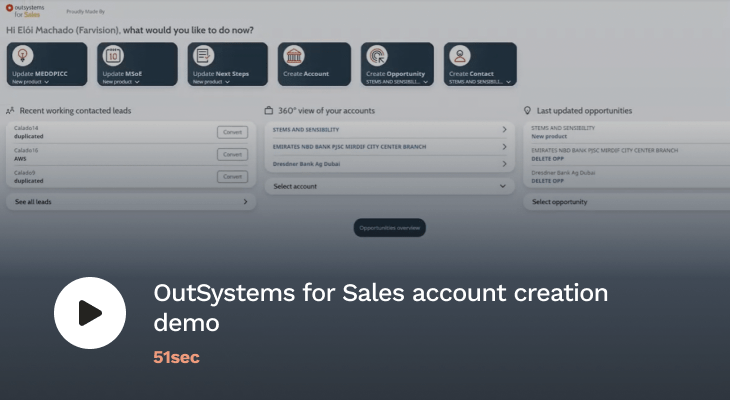
"By uncluttering the UI, we’ve made the user experience much more intuitive. Instead of users hunting up and down lengthy Salesforce.com screens for the fields they need, we give them just the fields they need when they need them."
Results
OutSystems for Sales—CRM Reimagined
Released to account managers and sales development reps in October 2021, OutSystems for Sales has made a massive difference to sales productivity, as well as the quality and completeness of CRM data.
Duplicate accounts are no longer accidentally created. Users spend less time populating fields as we pull through D&B data automatically. And crucially, sales forecasts are increasingly accurate and up to date.
The uncluttered user experience provided by OutSystems for Sales makes it faster and easier for users to get things right-first-time.
Why we chose OutSystems:
- Speed-up development and improve agility
- Powerful integration
- Improve UX
Keep reading
Discover OutSystems