

Product Releases
and Updates
Organizations in regulated industries are required to retain database backups for several years to satisfy strict audit, legal, and compliance requirements. To simplify this process, we are introducing Long-Term Backup Retention for OutSystems 11.
O11 now lets you configure database backup retention for up to 10 years directly within your production environment. These backups are stored as immutable, audit ready archives - no custom infrastructure to build or maintain on your side.
Available today for SQL Server.
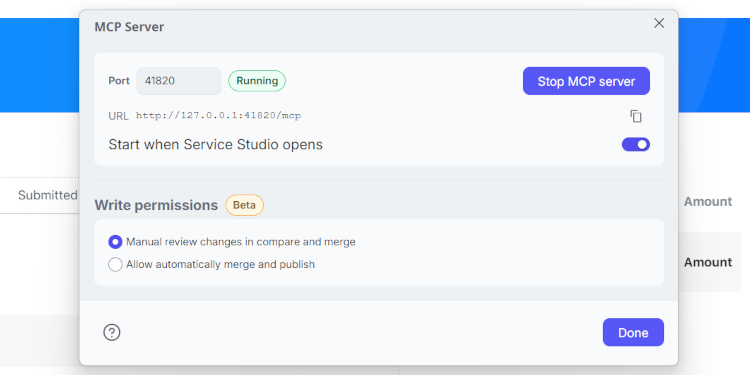
Your developers already use AI coding agents. Now those agents can work on your OutSystems 11 apps too. OutSystems 11 MCP adds a local MCP server to Service Studio, letting agents like Claude Code, Cursor, GitHub Copilot and Kiro read your application models and propose changes, governed by the O11 lifecycle you already run.
Everything runs on the developer's machine, in your own environment: cloud, on-premises or air-gapped. By default, agent changes arrive as a copy that a developer reviews in Service Studio's Compare-and-Merge before anything is applied.
Read scenarios for Reactive and Mobile apps are generally available. Write and edit, plus Traditional Web apps, are in Beta. Available to all O11 customers.
.png)
OutSystems Model Context Protocol (MCP) is now generally available on every ODC tenant. It's the integration layer that connects the coding agent you already use, such as Claude Code, Codex, Cursor, or AWS Kiro, to OutSystems. From a single conversation, you can build, ship, and operate your ODC portfolio, with the same governance you get in the ODC Platform.
Build more than apps. Describe what you need, and your agent hands the work to Mentor, our platform-native coding agent, which produces the same OutSystems app model as ODC Studio.
- Web apps – Create an app from a standard template or evolve an existing one, from data model to screens and logic.
- AI agents – Describe what an agent should do and get a complete configuration, including prompts, tools, and model settings, grounded in your app's data and logic.
- Workflows – Generate and change workflows that coordinate people and automated steps across your apps.
- Libraries – Build reusable libraries, or upload and publish C# external libraries when you need custom code.
Operate your portfolio.
- Understand your estate – Query the live enterprise context layer to search your tenant, inspect screens, data models, logic, and roles, and map dependencies and integrations between apps.
- Ship with confidence – Publish, see what's deployed in each stage, check the impact on dependent apps before you deploy, promote between stages, and roll back when needed.
- Keep apps healthy – Check app and environment health, logs, and traces to find and diagnose issues.
Every action runs as you, with your existing ODC roles, approvals, and audit trail.
Part of your toolchain. Your agent combines OutSystems MCP with the other tools it already connects to. Pick up a story from Jira, build the feature, deploy it to a test stage, run Playwright tests against it, and post a summary to Slack, all in one conversation.
Previously available through our early access program, OutSystems MCP is now ready for production use. Thank you to the early access developers whose feedback shaped this release.
Get started in one step. Copy this into your coding agent:
Install the OutSystems MCP from https://github.com/OutSystems/outsystems-mcp
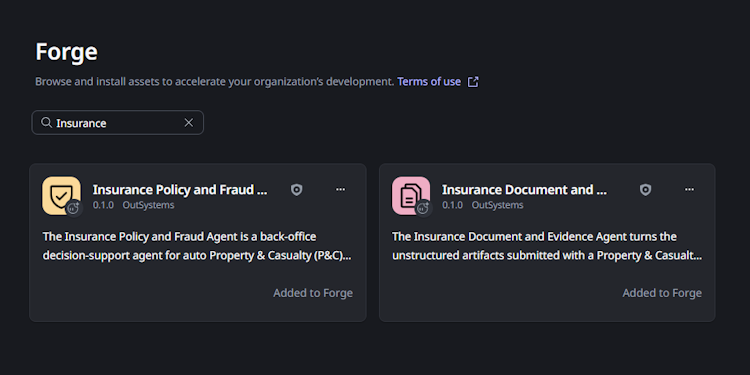
The Insurance Agent Kit is now available, expanding the OutSystems Agentic Industry Solutions portfolio for insurance. It brings two governed agents that you can import, adapt, and integrate to support First Notice of Loss (FNOL) processing within your own claims platforms and workflows.
The agents ground themselves in your operational context: your products, policies, systems, and risk thresholds. They surface evidence-anchored insights while every FNOL assessment remains under your control.
What you get:
- Evidence-anchored coverage and fraud analysis. The Policy and Fraud Agent analyzes policy wording, claim facts, evidence, and risk signals to produce a single JSON decision-support packet: coverage determinations per loss item, deterministic deductible calculations, fraud scoring (0–100) with indicator audit trails, severity tiering (1–4), reserve ranges, anomaly detection, and bias checks—all anchored to specific evidence.
- Structured evidence from unstructured loss notices. The Document and Evidence Agent converts unstructured First Notice of Loss (FNOL) artifacts: vehicle photos, scanned documents, and voice transcripts, into one structured JSON Evidence Package. It classifies each artifact, extracts fields with calibrated confidence, assesses image quality, flags integrity concerns as observations (never verdicts), and evaluates completeness against your checklist.
- A ready-to-run showcase to explore both agents. The Insurance AI Agents Showcase is a companion app with dedicated pages for each agent, multimodal document upload, full parameter visibility, agent configuration controls, and pre-loaded demo data—so you can see how the agents work before integrating them into your own FNOL workflows.
The Insurance Agent Kit is available on the OutSystems Forge, with building blocks for creating insurance apps and agents on the OutSystems platform.
Convert O11 apps to ODC at your own pace—when and where it makes sense.
To help you accelerate your modernization journey and take full control of your conversion timeline, we are excited to introduce yet another release of the O11 to ODC App Conversion Kit, this time in Beta.
Building on the foundation of our Conversion Assessment Tool (CAT)—already available in the Forge to help you evaluate and plan your transition—this end-to-end toolkit completes the experience. Once your apps are assessed and ready, our new Code Conversion and Data Transfer capabilities automate the heavy lifting of translating your code structures and moving your operational data seamlessly to ODC.
If you have an ODC tenant and one or more O11 infrastructure, you will automatically have access to Code and Data tools, in your ODC tenant go to Management > OutSystems O11 > App Conversion, after opt-in, you will be able to convert the plans that you have prepared with CAT.
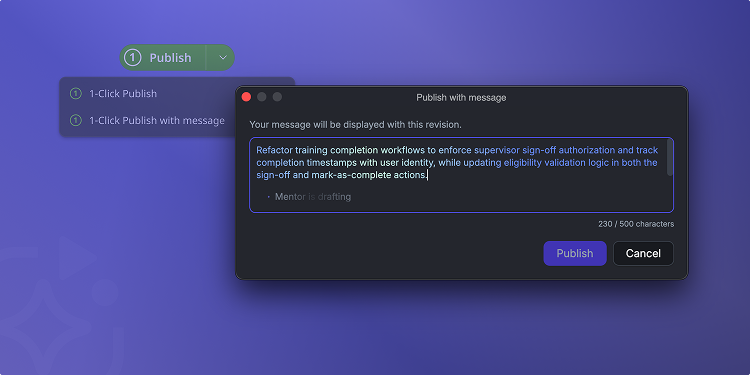
Every 1-Click Publish in ODC Studio is a chance to record what changed and why. In practice that record is often skipped or reduced to "fix" or "updates," and the cost shows up later, when someone comparing revisions, rolling back, or chasing a regression has to reverse-engineer intent from the code.
Mentor can now write the 1-Click Publish message for you. When you choose to publish with a message, Mentor analyzes the changes you're about to commit — new and modified screens, logic, data, and dependencies, then suggests a clear summary. You can accept it, edit it, or ask Mentor to rewrite it before publishing.
This provides a revision history anyone can use. Clear, consistent messages make it easier to compare versions, roll back changes, and review a teammate’s work.
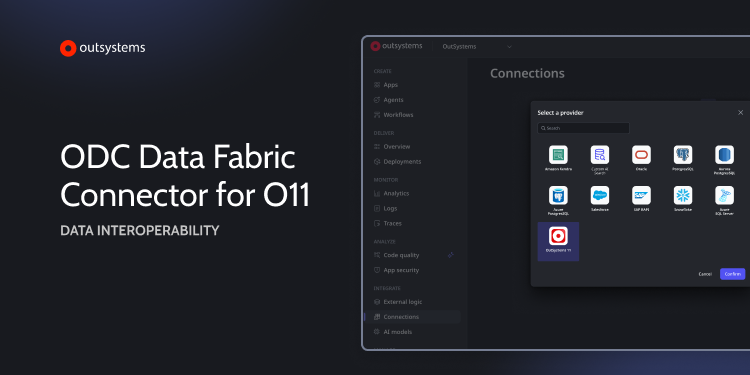
ODC Data Fabric Connector for O11 now supports multi-database catalogs on O11 self-managed infrastructures. This update is specifically for enterprise customers who enforce database-level data separation - whether for storage management, regulatory compliance, or performance isolation.
What has changed:
- Data Segregation Consistency: The connector routes automatically to the correct database catalog, preserving your existing O11 data segregation rules as you bridge data to ODC.
- Operational Flexibility: Your O11 database configuration and access policies remain unchanged — the connector adapts to your existing setup.
- AO-neutral usage: Consuming O11 entities in ODC remains AO-neutral, regardless of your database catalog configuration.
This update enables organizations with complex delivery architectures to ground ODC-based AI agents in business data stored across isolated catalogs — without collapsing your existing data boundaries.
We’re excited to share that OutSystems is now fully compliant with the UK government-backed Cyber Essentials Plus framework across both the OutSystems 11 and OutSystems Developer Cloud platforms. By adopting these stringent, independently verified security controls, OutSystems ensures that its infrastructure is fortified against a wide range of cyber threats, providing organizations with a highly secure environment for their digital transformation initiatives.
This certification directly accelerates procurement and simplifies governance for highly regulated organizations, including the UK public sector, healthcare, financial services, and more. By building on a foundation that meets these rigorous standards, your development teams can focus on delivering agentic systems rather than navigating complex compliance barriers.
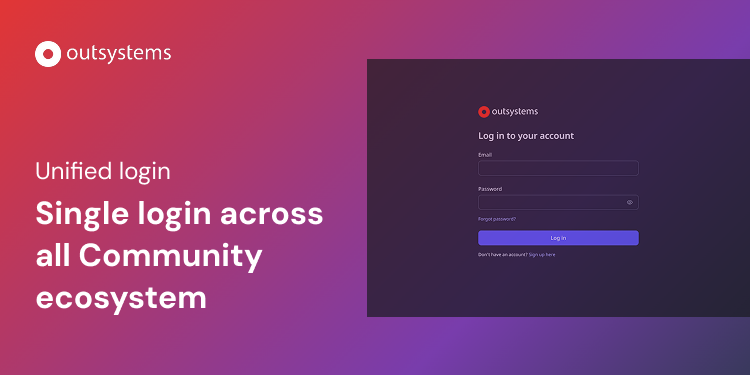
Community, O11 Personal Environment, and ODC Personal Edition now share a single login, replacing the fragmented authentication experience that required separate sign-ins across products.
Your identity is now stable and persistent: it follows you across the ecosystem, even through email address changes, and is no longer dependent on password replication across systems.
With this update, you can:
- Sign in once and move freely between Community, O11 Personal Environment, and ODC Personal Edition without being re-prompted to authenticate.
- Keep your existing credentials, no migration or new account required.
- Maintain a consistent identity across the OutSystems Community ecosystem, even when your email address changes.
- Benefit from a more secure authentication foundation, with passwords no longer stored or replicated across systems.
- Activate your account with a verification code, a more reliable and secure alternative to link-only activation.
Ready to build?

Unused dependencies accumulate over time and can disrupt deployments or cause unexpected runtime errors - even if your application never actively calls them. Because these dependencies are still part of your deployment plan, they make your app more vulnerable to breaking changes from modules you’re no longer using.
O11 now alerts you to unused producer references - such as an OutSystems UI reference where no widgets or patterns are used, or a producer module kept after a refactor with none of its actions or entities called - directly in LifeTime while creating your deployment plan. Before staging, you will see a list of flagged producers, allowing you to decide whether to clean them up, recalculate the plan, or proceed with full visibility.
Minimum versions: Platform Server 11.41.1, LifeTime 11.32.0