
Full-Stack-Entwicklung für alle
Mit der OutSystems-Plattform steigen Ihre Mitarbeiter in neue Rollen. Backend-Entwickler erstellen Frontends, Frontend-Entwickler erstellen Backends, und alle Entwickler automatisieren Workflows. Ohne Limitationen, Stolpersteine oder Toolwechsel. Sie erhalten hochwertige, plattformübergreifende Applikationen, die sich einfach erweitern lassen.










13 kritische Apps in drei Monaten entwickelt
14.000 verwaltete Assets
1 zusätzlicher Entwickler eingestellt

.svg)
Frontends leicht gemacht
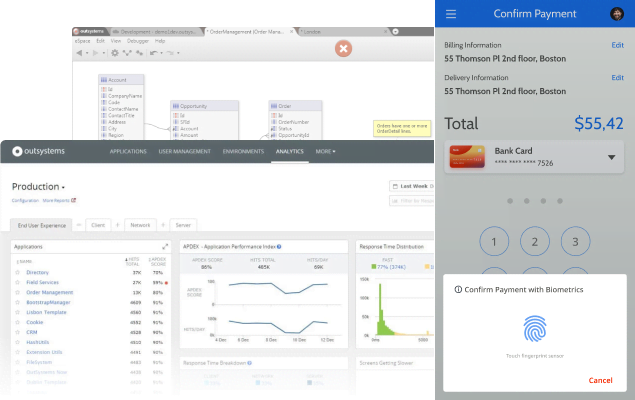
Die Low-Code-Plattform von OutSystems macht Frontends zum Kinderspiel, selbst wenn Ihr Team noch nie eins erstellt hat. Die Plattform verbindet Designer mit Entwicklern, lässt sich mit Figma integrieren und bietet fertigte Vorlagen. Das Ergebnis? Ansprechende Applikationen und absolut reibungslose Benutzererlebnisse.

Backend-Entwicklung für alle Qualifikationsstufen
Neue und professionelle Entwickler können die Low-Code-Plattform von OutSystems nutzen, um Ihr Backend zu erstellen, einschließlich APIs, Webservices, Datenmodellen, Workflows und Geschäftsregeln. Das Erstellen und Strukturieren von Datenbanken und Abfragen, Geschäftslogik und Integrationen ist ebenso einfach.
Automatisieren statt duplizieren
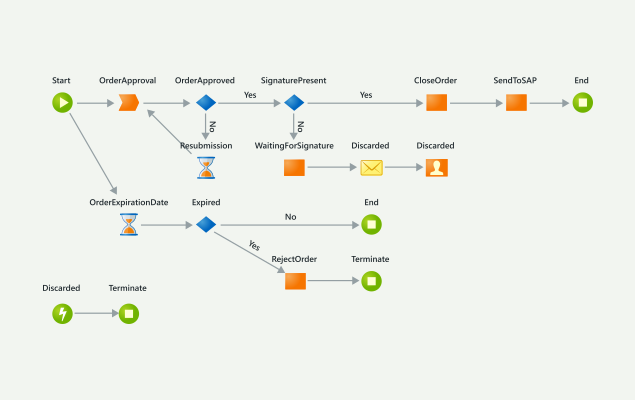
Die OutSystems-Plattform ermöglicht es neuen, erfahrenen und professionellen Entwicklern, maßgeschneiderte Applikationen zu erstellen und bereitzustellen, die Ihre einzigartigen funktionsübergreifenden Workflows automatisieren und orchestrieren und so Ineffizienzen und repetitive Aufgaben eliminieren.
Need to extend an app? No problem
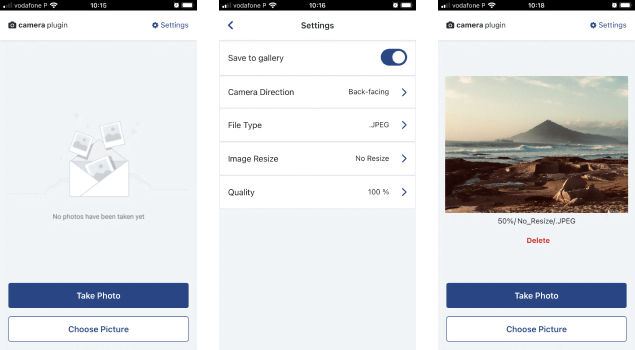
Extending or changing an app is a snap with the OutSystems low-code platform. Developers can add widgets, facial recognition plug-ins, pricing engine algorithms, and more as built-in visual elements in the OutSystems environment that you can easily add to your applications.
Application
development FAQ
Yes. OutSystems supports team development with built-in versioning, merge, and conflict resolution capabilities. Developers can work on the same application, compare changes, resolve conflicts, and publish updates through governed workflows. This helps teams collaborate without losing visibility or control across shared application development projects.
OutSystems generates standard backend and frontend code using widely adopted frameworks and languages. The backend is based on .NET and C#, while the frontend uses JavaScript, HTML, CSS, and React. Developers build visually, but the platform produces enterprise-grade application code aligned with modern web development practices.
Developers don’t directly edit generated code in the OutSystems IDE. However, OutSystems provides a detachment process that allows customers to export applications as standard .NET and React applications if they choose to leave the platform. This helps address code ownership and vendor lock-in concerns while preserving long-term flexibility.
Yes. OutSystems supports custom C#, JavaScript, and CSS when teams need capabilities beyond visual low-code development. Developers can also create .NET extensions for specialized requirements. This gives teams the speed of visual development while preserving flexibility for complex logic, integrations, and AI development use cases.
OutSystems supports many types of software, including AI agents, web apps, mobile apps for iOS and Android, progressive web apps, APIs, and microservices. Teams can build simple CRUD tools, enterprise workflows, customer portals, and complex mission-critical systems on one platform.
The default OutSystems database size is 100GB and can be increased at an additional cost. For document-heavy applications or very large datasets, teams can integrate with dedicated storage services such as AWS S3. This helps keep application data scalable while using the right storage model for each workload.
You don’t need specialized AI developers or a single mandated coding tool to build with OutSystems. Teams can use developers with object-oriented, database, and web experience, while tools such as Claude, Copilot, Koda, or Codex can support upstream work. OutSystems provides the governed AI development platform for building, integrating, and managing apps and agents.
OutSystems supports accelerated development by helping teams build applications up to 10 times faster than traditional coding. Simple applications can be delivered in days or weeks instead of months. OutSystems AI further speeds delivery with AI-assisted development, app generation, recommendations, and automation across the software development lifecycle.
OutSystems offers free online training, guided learning paths, certification programs, community forums, technical documentation, professional services, and technical support. Customers can also work with partners or Technical Success Managers for hands-on guidance. This support model helps teams ramp faster and build the skills needed for long-term platform success.
Yes. OutSystems is built for code reuse through modular architecture, reusable components, shared services, and UI elements that can be used across multiple applications. Reused components only count once in the licensing model, helping teams improve consistency, reduce duplication, and accelerate development across an application portfolio.
OutSystems handles complex business logic through visual workflows, conditional logic, data transformations, complex queries, and workflow orchestration. Developers can also extend logic with custom code when needed. This gives teams a structured way to build sophisticated enterprise applications without losing flexibility or control over business rules.
OutSystems includes app testing capabilities such as built-in debugging, visual step-through debugging, and support for behavior-driven development testing. Teams can also integrate with external testing tools such as Selenium and TestIM. This helps QA and development teams validate functionality throughout the development lifecycle.
Yes. OutSystems supports automated testing through its behavior-driven development framework and integration with third-party testing tools. Teams can use app testing, automation, and automated testing practices to validate functionality, reduce manual QA effort, and maintain quality as applications evolve across environments.


Erstellen Sie, was in Ihrem Backlog ist
Das breiteste Angebot an Anwendungsfällen, Vorlagen und leistungsstarken Partnerlösungen hilft Ihnen, alle Applikationen in Ihrem Backlog zu realisieren.

Sehen Sie, wie OutSystems im Vergleich abschneidet
Erhalten Sie die neuesten Studien über Low-Code-Plattformen von globalen Branchenanalysten und erfahren Sie, warum OutSystems als führende Low-Code-Plattform gilt.

Steigen Sie tiefer in die Plattform ein
Weitere Details über OutSystems finden Sie in unserem Evaluierungsleitfaden.