Many AI projects stall at the same question: “Where does our data go?” The same question stalls legacy modernization projects. Many of the systems organizations most want to update, such as core banking platforms, policy administration systems, and government case management systems, run on premises because regulations require their data to stay there. When modernizing means moving that data to someone else’s cloud, the project often stops before it starts.
This post looks at how OutSystems helps you answer the question for your AI agents: where they run, and which models they call.
In my conversations with customers across the Gulf, some tell me that the AI itself isn't the reason the AI agents haven't gone live. What I hear instead is “Legal won’'t sign off,” “We don’t know where the data ends up,” or “Our compliance team asked a question we couldn’t answer.” These statements map to sovereignty questions: who owns the infrastructure the AI runs on, who operates it, and what happens to the information that passes through it.
OutSystems gives you more than one way to answer them. This matters because many people evaluating AI platforms assume they must send their data to somebody else’s cloud and hope for the best. But organizations should not have to hope for the best when it comes to running their mission-critical applications, agents, and sensitive workloads.
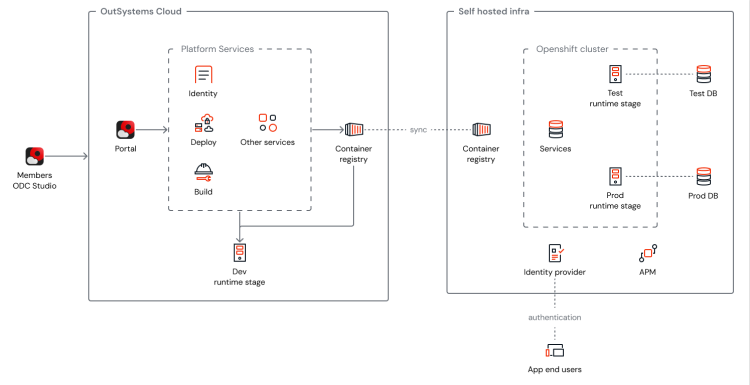
That’s why OutSystems launched the OutSystems Self-hosted runtime. Application development stays in your build environment on OutSystems Developer Cloud (ODC). However, Test and Production run on your own infrastructure your organization controls, including your data center, private cloud, and whatever your IT team already operates. You also choose the stack it runs on, such as Red Hat OpenShift, a managed Kubernetes service from AWS, Google, or Oracle, or a custom build your own team manages.
In practice, that means your development team keeps the fast, zero-maintenance experience of building in the cloud, and the environments where sensitive customer data flows through the system stay under your control.
This also changes the math on legacy modernization. You can rebuild an aging application on OutSystems and run the new version in the same data center as the system it replaces, close to the data it depends on. Old and new systems can run side by side during the transition, so your team can replace a legacy system one piece at a time and retire it when the new version is ready.
Going further: Development on your infrastructure, then a disconnected option
For organizations that want their development environment on their own infrastructure too, or need occasional cloud connectivity rather than always-on, the Self-hosted runtime is evolving in two steps.
Development on your own infrastructure
This extends the same idea to development, so Dev, Test, and Production run entirely on your own infrastructure. The only things still connecting back to ODC are the central portal you use to govern everything, and the platform services that keep your build pipeline current, such as automated compilation, continuous upgrades, orchestration, governance, and dependency analysis.
A fully disconnected option
This is the deepest level of isolation. The self-hosted side becomes close to fully self-contained. It runs its own authorization and identity services, its own core control systems, and all three runtime stages, with only a deliberate, controlled sync back to the cloud (for things like pulling container images or shipping telemetry). It’s built for the most locked-down environments, such as:
Defense and intelligence
Government agencies running classified or national-security workloads
Critical infrastructure operators in energy and utilities
Manufacturers whose plant networks are deliberately isolated from the internet
You don’t have to choose the deepest isolation option to start. The Self-hosted runtime already covers many of the compliance conversations we have today, and these next steps give you a credible answer when a customer or regulator asks, “What if more isolation is needed later?”
Follow a request: Where your agent’s data goes
Deciding where your agents run is one half of sovereignty. The other half is what happens every time an agent does its job. In ODC, each agent request goes through the same four steps:
It gathers context. The agent pulls the information it needs, such as a customer’s history, a policy, or a product catalog, from your own databases and applications, including the core systems your business has run on for decades.
It builds the prompt. That context is combined with the user’s request and the agent’s instructions.
It calls the AI model. The prompt goes to the model, which sends back a response.
It remembers. The conversation and results are saved, so the agent can pick up where it left off.
On the Self-hosted runtime, steps 1, 2, and 4 run in your Test and Production environments on your infrastructure. Apart from any external tools you deliberately connect, step 3 is the only point where your data leaves the runtime, and where it goes depends on the model you choose.
This matters most for agents that work with your existing core systems. When an agent runs on your infrastructure close to a legacy system of record, it can read from and update that system without sending the data across the internet. OutSystems agents connect to core business systems through prebuilt connectors, so you can modernize a process with agents and keep the system of record where it is.
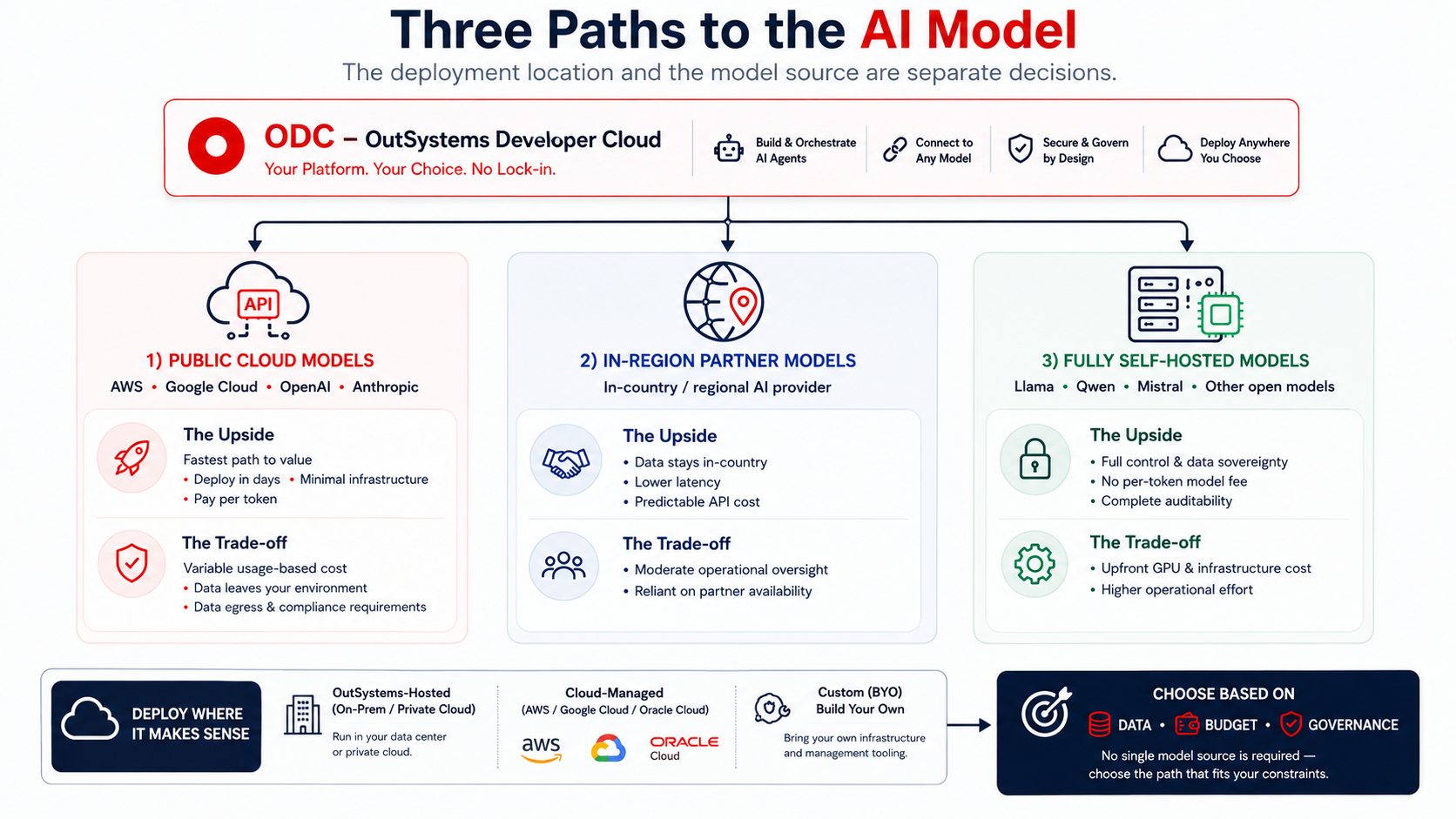
Public cloud models: The fastest path
Deploy in days, pay per token, and manage almost no infrastructure. The trade-off is variable, usage-based cost and the need to satisfy data-egress compliance requirements, since your prompts leave your environment to reach the provider.
In-region partner models: A middle ground
Your data stays in-country, response times are typically faster than a distant public cloud region, and API costs are predictable. The trade-off is a moderate amount of ongoing operational oversight and reliance on a regional partner’s availability.
Fully self-hosted models: Full control
Run open-source models on your own infrastructure, so there’s no per-token model fee, and the whole request, from context to response, stays on infrastructure you control. The trade-offs are upfront GPU and infrastructure cost and the additional operational effort to keep it running.
Combine the Self-hosted runtime with an in-region or self-hosted model, and every step of the request stays in your control or inside your borders. ODC connects to cloud providers natively and to your own private models through custom connections, and each agent picks its own model, so you can choose per use case and change your mind later.
Where local models already deliver
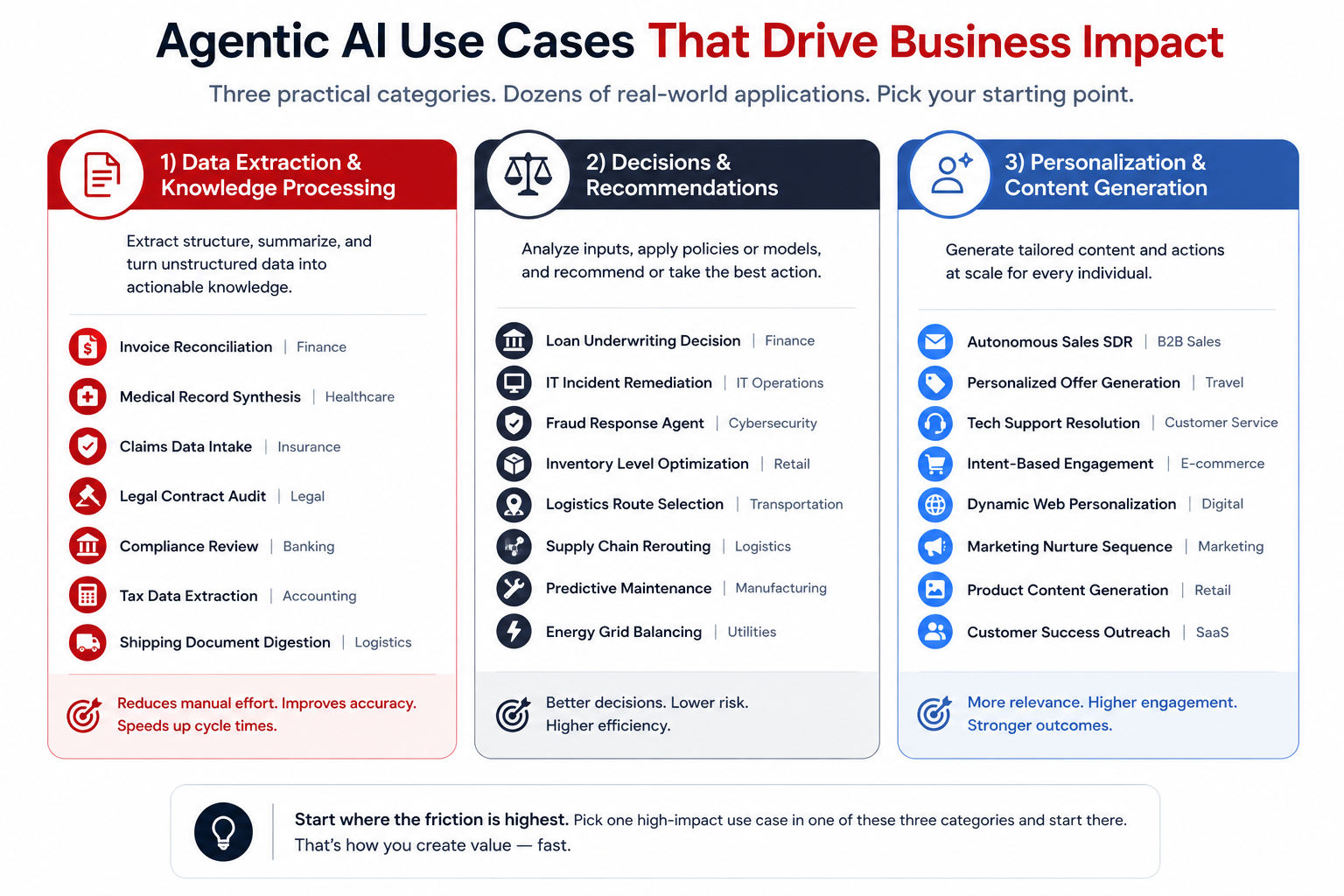
Another belief I run into often is that a useful AI agent needs the biggest, newest, and shiniest model. For most agent work, it doesn’t. The following tasks are focused and well defined, and models running in-region or on your own servers handle them well and often more efficiently:
Reading documents and extracting data, such as claims intake, medical record summaries, contract review, and invoice reconciliation.
Making decisions against a policy, such as loan underwriting support, fraud triage, and IT incident remediation.
Writing personalized responses, such as customer replies, tailored offers, and support resolutions.
These are the use cases that handle your most sensitive data, which is why running them on a model you control matters. They are also some of the most common processes still running on legacy systems. Start with the one that causes the most friction today and pick a model that fits it. For example, adding an agent to claims intake or underwriting support is a practical first step in modernizing a process, and you can do it before replacing the core system behind it.
If you’re evaluating AI agents now
If your organization has been holding off on AI agents because you couldn’t get a straight answer about data control or infrastructure ownership, that’s worth revisiting. There’s a Self-hosted runtime available today that keeps your agents and the data they handle under your control, and a path toward full self-hosting. Beyond that is air-gapped isolation for the organizations that need it. And the models your agents call can run in-region or on your own servers, without giving up what they can do.
The same is true for modernization. If an aging system has stayed in place because its data can’t leave your environment, you can rebuild it on OutSystems, run it on your own infrastructure, and add agents that work with the core systems you keep.
For regulated industries, the question changes from “Can we even do this?” to “Which systems should we modernize first, where should our agents run, and which model should they call?” And that last question is a far easier one.
If you’d like to see how the OutSystems Self-hosted runtime applies to your data sovereignty needs, please contact us for a demo.
Amr ElRefaie is a Senior Solution Architect at OutSystems, based in Dubai, partnering with public sector, banking and financial services, telecom, IT, and BPO organizations across the Middle East and Africa. As the OutSystems Subject Leader for AI in EMEA, Amr helps enterprises move from AI experimentation to governed, production-grade agentic applications, while designing secure, sovereign, and self-hosted architectures for highly regulated environments. With more than 18 years of experience spanning enterprise and cloud architecture, cloud automation, and ITSM automation and analytics, Amr is certified across OutSystems, AWS, Microsoft Azure, Google Cloud, and ITIL. Outside of customer engagements, Amr is usually testing the newest AI tool before it trends.