“OutSystems is a strong choice for large enterprises that need both AI-assisted application development and governed production-agent deployment on a mature platform.”*
AI-assisted development experience, platform governance, and enterprise roadmap application delivery are the three areas the report covers. Let’s look at them in more detail.
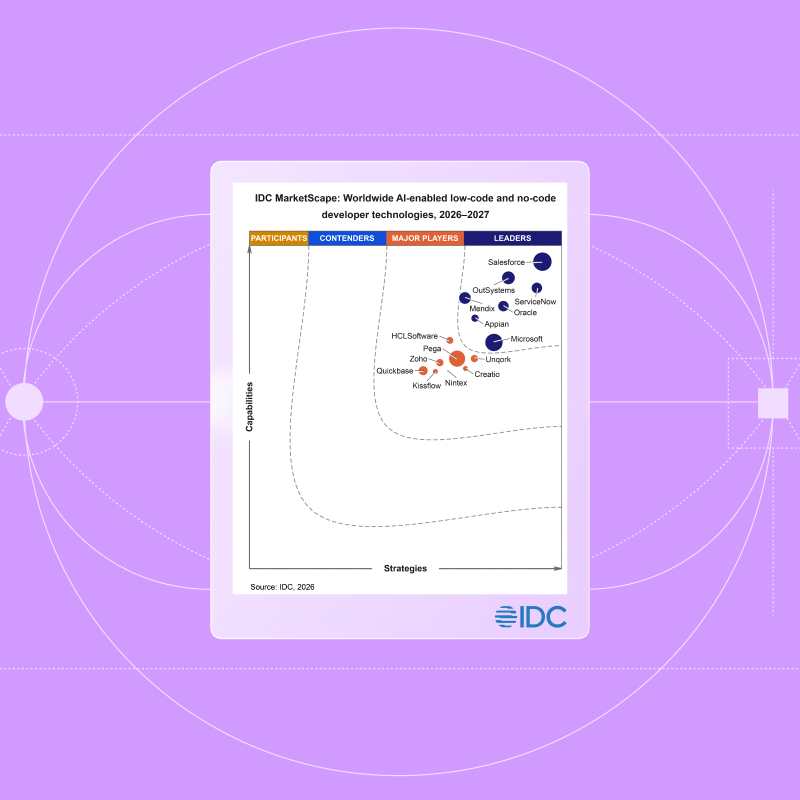
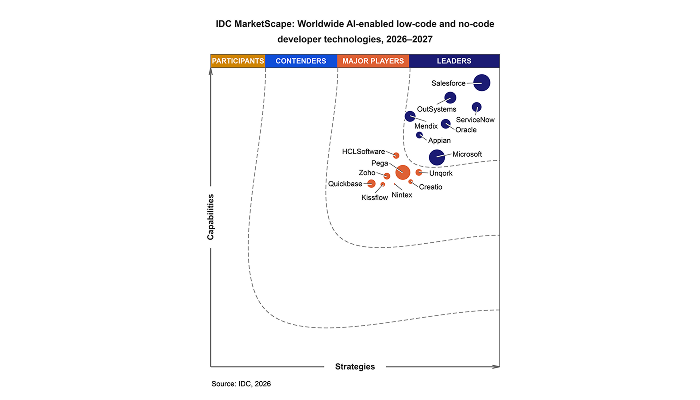
IDC MarketScape vendor analysis model is designed to provide an overview of the competitive fitness of technology and suppliers in a given market. The research methodology utilizes a rigorous scoring methodology based on both qualitative and quantitative criteria that results in a single graphical illustration of each supplier’s position within a given market. The Capabilities score measures supplier product, go-to-market and business execution in the short-term. The Strategy score measures alignment of supplier strategies with customer requirements in a 3-5 year timeframe. Supplier market share is represented by the size of the icons.
What we believe our recognition means for our vision
Being a Leader in this IDC MarketScape is meaningful to us because of the strengths it noted. We have a vision whereby foundation model integration (large-scale AI systems trained on massive datasets) and model-harness optimization (the automated process of tuning a software wrapper around a large language model) help improve:
How developers build with AI
How teams run agents in production
How all of it is governed
How much of the enterprise the platform can see.
AI-assisted development that keeps models out of the way
Getting value from AI assistance shouldn’t depend on how well a developer writes prompts.
According to the IDC MarketScape, “OutSystems uses Mentor to give developers a common AI-assisted development experience without making model integration a prerequisite for adoption. The platform abstracts the complexity of working across multiple models while preserving a consistent interface for development teams.”*
By removing multimodel complexity, Mentor frees teams to put their attention on the application’s logic and data, along with the business problem it solves.
“By leveraging OutSystems and Mentor, we are accelerating delivery, improving quality, and creating scalable solutions that drive meaningful business value," explains Alan Conway, director of software engineering at SRS Distribution. A subsidiary of Home Depot, SRS Distribution serves professional contractors in 1000 U.S. locations.
Your choice of model for production agents
Getting help while building is one job. Running agents in production is another, and OutSystems deliberately keeps the two separate.
Mentor handles development-time assistance. At runtime, OutSystems lets teams choose the LLM each agent uses, based on performance, cost, security, and workload. Because that choice belongs to the customer, production agents avoid lock-in to a vendor’s cloud or inferencing and the unpredictable usage costs that come with it.
One governance model for code, AI-generated apps, and agents
When AI-generated apps and agents get their own approval process, teams end up maintaining two sets of rules for the same software.
The IDC MarketScape states “OutSystems extends one governance and release model across human-built applications, AI-generated applications, and agents. Existing quality gates, deployment practices, and access controls can extend across all three without the need for parallel processes, which supports a more consistent operating model as AI-generated applications and agents become part of the production estate.”*
For platform and security leaders, that means one place to set policy and one release process to oversee, whether a person or AI wrote the change.
"We wanted to implement agentic AI into our business and OutSystems gave us the confidence to do it. The embedded guardrails and governance tools prevent rogue AI and protect our private information while ensuring AI remains grounded in our internal data. That’s the only right way to innovate with AI," says Mike Neyman, director of software integration and operations at iconic sign maker YESCO.
Full visibility across the application portfolio
AI that generates changes without knowing what else depends on them creates architectural drift: small, reasonable-looking changes that add up to systems nobody planned.
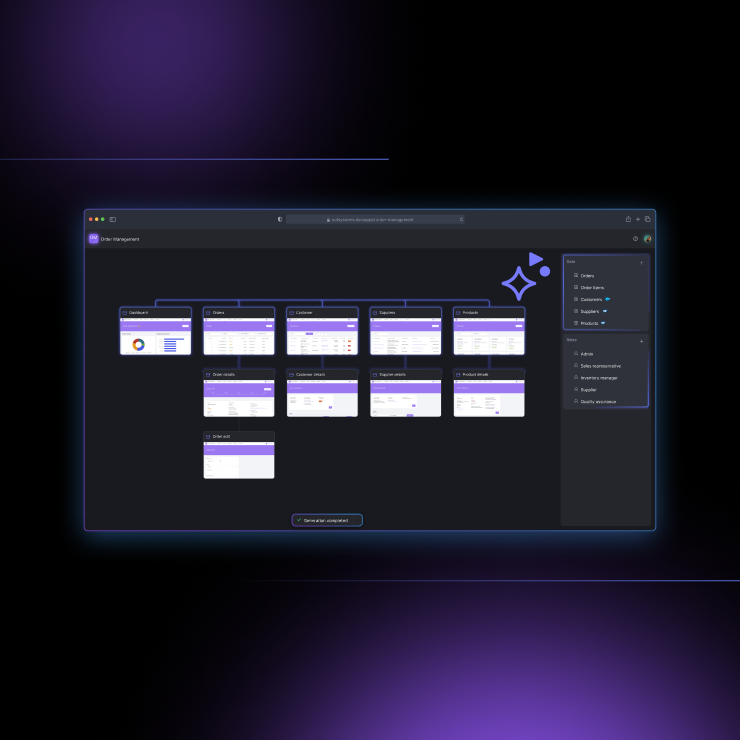
The IDC MarketScape notes, “The OutSystems Enterprise Context Graph gives developers and agents a structured view of applications, workflows, and dependencies across the enterprise estate. That shared context allows AI-assisted changes to be evaluated against existing architecture, with full knowledge of surrounding systems.”* We’re honored by this statement, because we built Enterprise Contex Graph to be sure OutSystems gives AI the context it needs.
Teams catch conflicts before deployment instead of discovering them in production, so the estate stays coherent as AI takes on more of the work.
The bottom line
Governed AI development and agents. Model choice without lock-in. Visibility across the entire application portfolio. With OutSystems, enterprises get an agentic systems platform that that provides what they need to:
Build with AI
Run agents in production under one set of controls
Since she first used a green screen centuries ago, Forsyth has been fascinated by computers, IT, programming, and developers. In her current role in product marketing, she gets to spread the word about the amazing, cutting-edge teams and innovations behind the OutSystems platform.