Agents of change: Leaders getting results from agentic AI
AI coding tools can generate functional applications in seconds, but deploying these fragmented, unmanaged solutions into an enterprise environment introduces severe risks. Without a unified control layer, organizations face uncontrolled build environments, architecture drift, data sprawl, and an alarming rise in production incidents. Scaling AI from a conversational prompt to production requires significant change in how applications are structured, governed, and orchestrated. But once organizations make this shift, they can scale securely and lead their markets as agentic enterprises.
The shift to Agentic Systems Engineering
Agentic Systems Engineering (ASE) strips away the complexity of managing disjointed large language model (LLM) stacks. It provides a single, open platform equipped with built-in observability and strict governance. The foundation of this breakthrough is the OutSystems Enterprise Context Graph.
This dynamic engine maps your entire enterprise architecture in real-time by tracking interconnected data dependencies, workflows, business logic, and security policies. AI agents require this rich context to function safely across complex systems. Also, when you embed this living model directly into your development lifecycle, your agents operate securely within your specific enterprise guardrails.
Real-world proof: Leaders driving agentic ROI
Forward-looking companies are already leveraging this approach to modernize legacy systems. Here are a few examples:
- HEINEKEN: By simply uploading business requirements to OutSystems Mentor, HEINEKEN generated 80% of an event engagement app with complex data models, server-side logic, and essential UI screens. In a matter of seconds, HEINEKEN had an MVP.
- SRS Distribution (The Home Depot Group): Uses OutSystems to manage over 90 internal apps for pricing, acquisitions, and operations. By leveraging AI-assisted development, the company has dramatically boosted developer productivity and accelerated delivery for workflows like automation, proving how AI can supercharge application modernization.
- Thermo Fisher Scientific: Using OutSystems Mentor, Thermo Fisher transforms uploaded documents into ready-made applications—including the UI, business logic, and data models—in just a few minutes. This allows their development teams to bypass tedious technical setup and focus purely on solving high-value business problems.
One unified, governed ecosystem
This architecture seamlessly supports an open ecosystem. Claude Code or Cursor users, designers working in Figma, and OutSystems developers creating agents with Mentor can all contribute to the same governed software estate. Every AI-generated change passes through automated evaluations and policy validations before deployment. You can secure the rapid speed of AI development while guaranteeing architectural consistency by design.
From prototype to production
Tech visionaries are already leveraging this approach to orchestrate complex workflows, modernize legacy core systems, and deploy self-optimizing internal applications. In a fraction of the traditional time, organizations move from disconnected AI prototypes to governed, production-ready systems.
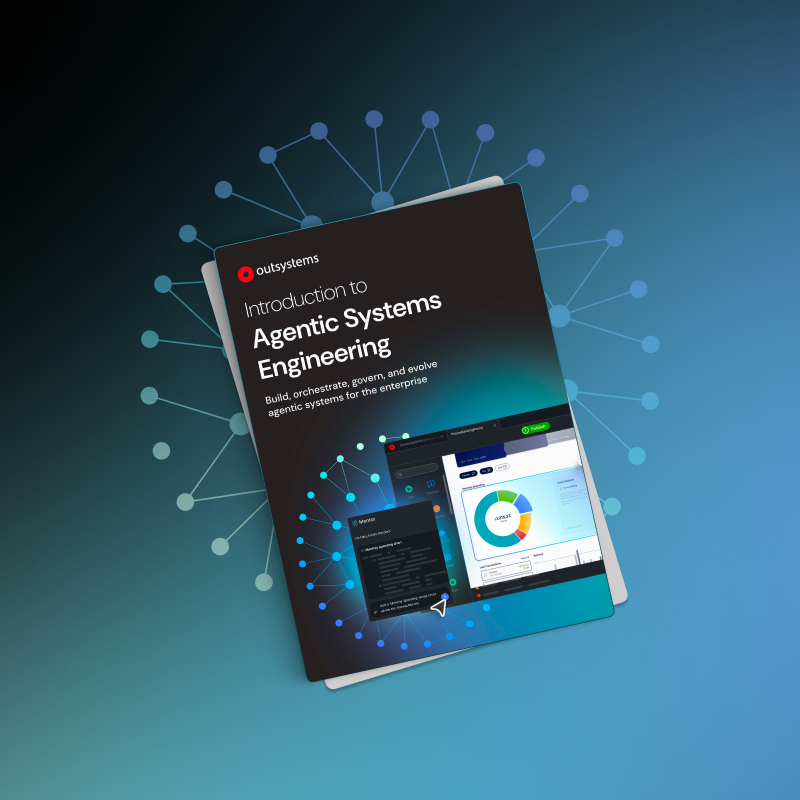
Download our latest ebook, Introduction to Agentic Systems Engineering, and discover why it’s the best way to build your agentic future.