The building blocks of a truly unified agentic systems platform
OutSystems solves that tension with one open, unified platform for engineering, orchestrating, and governing agentic systems. Every OutSystems capability delivered in the second quarter (Q2) of 2026, which was one of our strongest quarters in terms of release and volume, reinforces that core idea. There are 27 updates that enhance the OutSystems platform so you can engineer, orchestrate, and govern agentic systems that deliver true enterprise impact across four critical areas.
1. Govern with a unified, model neutral platform
An open agentic systems platform with the Enterprise Context Graph at its core grounds any coding tool or LLM in a shared operational knowledge layer. Enterprise governance and flexible deployment is built in.
2. Engineer systems starting from any coding tool
You can build in OutSystems using Mentor, or your teams can use the external coding tools and agents they already use today.
3. Orchestrate your workforce
With Agent Workbench, you have full control to coordinate multi-agent workflows across your entire ecosystem. This control also gives you the flexibility to swap underlying AI models to cut costs and optimize performance.
4. Accelerate time-to-value with industry solutions
For highly regulated sectors like banking, insurance, and the public sector, we provide pre-built, governed agentic systems for the work every business in the industry shares. These are ready to customize to your own rules and systems, so teams ship outcomes in weeks.
Ultimately, OutSystems is the only proven, enterprise-grade platform that you can use to transform your existing core systems and legacy applications with AI. Key to its transformation capabilities is the Enterprise Context Graph.
Enterprise Context Graph: The centralized knowledge layer
The OutSystems Enterprise Context Graph represents your organization's unique application landscape as a live, structured, and queryable knowledge layer. With this layer in place, AI agents can understand how applications, agents, workflows, data, business logic, and dependencies relate to one another. As a result, they can reason more accurately, assess impact before taking action, and execute with greater precision. In addition, the Enterprise Context Graph enables institutional-grade governance with built-in compliance, security guardrails, and flexible deployment (cloud-native, sovereign, hybrid).
The rest of this blog highlights the updates that contribute to making building faster and governing smarter possible. Most of these capabilities are now generally available (GA), while some are part of our Early Access Program (EAP), and two are in beta testing (beta).
Deploy securely, govern at scale, and accelerate AI innovation
Most enterprises today feel stuck between allowing chaotic ungoverned AI sprawl or imposing rigid lockdowns that choke innovation. The latest OutSystems releases deliver a third option. Developers now have the freedom to build with the AI tools they love, while equipping IT with live enterprise context and institutional-grade governance.
Expand your reach with new integration options
With two new connectivity features, your applications can reach outward. Use the MCP client to connect OutSystems apps and agents to third-party tools and SaaS platforms using open standards and deliver faster, lower-cost integrations without custom code. With native Snowflake grounding, currently in beta, you can model data directly in your Enterprise Context Graph to feed real-time analytical context into app workflows. No complex pipelines are required.
Supercharge O11 without “rip-and-replace”
If you're a customer operating on OutSystems 11 (O11), stepping into the agentic era shouldn't mean discarding years of proven software development. The path from OutSystems 11 to ODC is on its way to becoming completely frictionless with:
- Data interoperability: Ground new ODC agents directly in existing O11 databases with full read-write access and zero data migration.
- Logic interoperability: Reuse core O11 business rules directly within ODC applications without code duplication.
- Cross-platform SSO: Ensure seamless user experiences across O11 and ODC with single sign-on that eliminates dual logins.
By uniting open tool choices, rich enterprise context, and effortless backward compatibility, OutSystems gives you the power to scale AI safely.
Streamline software delivery with stronger release oversight
AI agents, apps, workflows, and shared libraries all have different governance, security, and operational requirements. With ODC Asset Portfolios, you can organize your software factory by business need or risk profile. You can apply portfolio-specific policies, delivery models, and runtime configurations while maintaining centralized governance across the platform. Support for up to ten non-production environments enables the flexibility to build release pipelines that reflect real-world development and testing processes. And with enhanced DevOps APIs, revision comparison, and richer publish and revision messages, automating releases, strengthening auditability, and maintaining visibility into every change just got even easier.
Engineer with Mentor or any coding agent
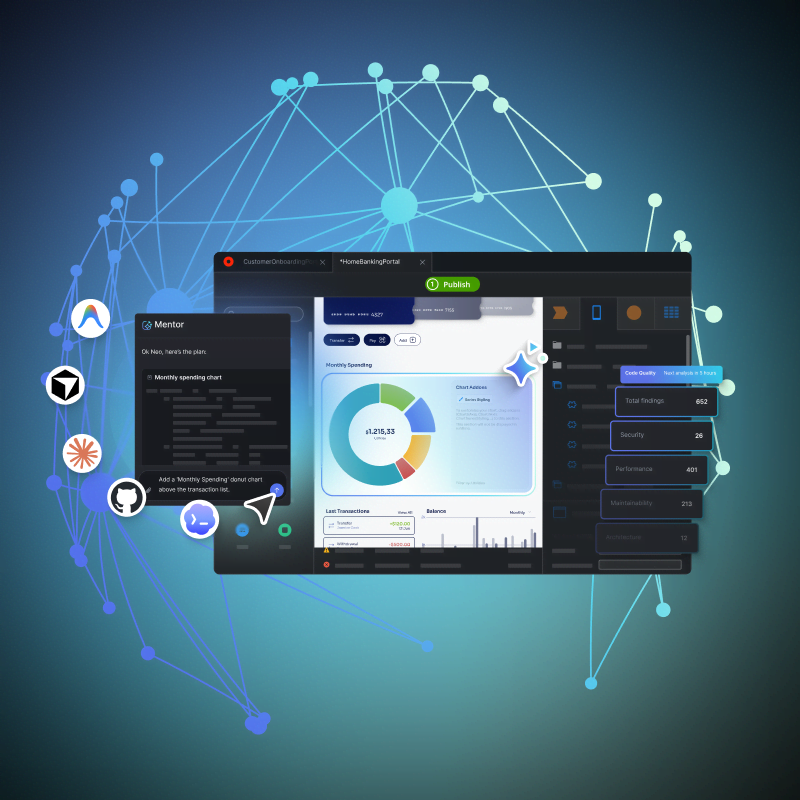
Engineering agentic systems must be able to deliver speed and control. Mentor, our platform-native coding agent, gives developers both, and in Q2, it got considerably more capable.
Bring your own tools with Agent Experience for ODC
While the MCP client and native Snowflake grounding enable outward connections, Agent Experience lets external tools reach inward. Now in EAP, Agent Experience introduces an MCP layer that seamlessly bridges OutSystems with modern AI coding environments. With Agent Experience, engineers can connect tools like Claude Code, Cursor, or Codex directly to ODC applications.
Architecture-aware grounding enables agents to read the full application model—including entities, screens, and dependencies—so every generated change fits your real system logic. And with automation-first controls, routine operations like refactoring and cleanup, and publishes automatically inherit your platform permissions and portal approval gates.
Speed up day-to-day development
A new Mentor feature (in beta) generates full agent configurations, including instructions, tools, and model settings, just from a plain-language description, with conversational refinement afterward. Conversational code comparison lets developers preview AI-generated changes side by side with the current app before applying them, so nothing gets approved as an all-or-nothing bundle. And Mentor's coding agents now deliver higher output quality and a near-perfect task success rate. New support for Libraries in ODC Studio makes reusable logic easier to build and refine.
Integration with Amazon Kiro
A new integration with Amazon Kiro is in EAP. Kiro translates developer intent into precise specifications, covering requirements, APIs, schemas, and tasks. Developers can then delegate that spec-driven work to Mentor, which generates the application in OutSystems, grounded in the Enterprise Context Graph. Because everything runs through the platform, governance comes built in. Teams can review changes, validate quality, deploy, and roll back using the lifecycle controls they already trust.
Analysis of complex legacy systems with AWS Transform
Another OutSystems and AWS collaboration in EAP powers a capability that eases the path to legacy modernization. AWS Transform analyzes complex legacy systems, including COBOL and Java, to surface their structure and business rules. Architects then use Kiro and Mentor together to translate those insights into modern specifications and rebuild the functionality as governed, agentic OutSystems applications. It's a guided path from legacy analysis to production, one that keeps human oversight at every stage.
Orchestrate with Agent Workbench
If you've built 100 agents, but they're not coordinated, you have a mess on your hands. You can avoid it with Agent Workbench, which enables you to turn multiple agents into a governed, coordinated system. The Q2 Agent Workbench releases focused on cost reduction, enterprise-grade safety, and AI ecosystem expansion.
Cost and flexibility supported by AWS
An expanded partnership with Amazon Bedrock now gives teams access to more than 100 large language models through a single set of credentials. Your teams can choose the right model for the right job, and swap models as pricing or performance shifts, without rewriting any underlying logic.
Safety built into the runtime
With OutSystems, Agent Guardrails are built directly into the runtime rather than bolted on. That means agents can't bypass them once a team turns them on. These guardrails power three key areas of protection, including detecting and blocking prompt attacks, protecting customer data by masking or blocking PII, and filtering harmful content.
Reliability through repeatability
Agent Evaluations replace manual, one-off testing with a repeatable validation process. Teams upload a “golden dataset” of test cases, and the platform scores every result automatically, flagging a pass or fail for each one. A full execution trace shows exactly what an agent did and which tools it called.
Reach through a uniform protocol
Using the new A2A connector, OutSystems agents can discover and call skills from external agents through a uniform protocol. Enterprises rarely run agents in just one ecosystem, and this connector keeps those systems from becoming siloed, no matter what platform they run on.
Accelerate with Agentic Industry Solutions
Not every problem needs to be solved from scratch. Agentic Industry Solutions package the patterns proven across enterprise deployments into mostly complete, deployable systems. The last mile is to make it yours.
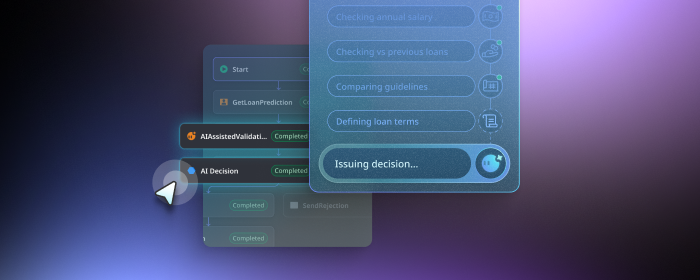
The first release in this portfolio is the Banking Agent Kit, available now on Forge. It includes three agents tailored to the consumer lending process. The Document Intelligence Agent validates application data against submitted documents and returns verified results, flagging any discrepancies. The Policy and Support Agent answers questions from banking documentation, with cited summaries. And the Risk and Fraud Assessment Agent surfaces potential fraud and gaps in know-your-customer (KYC) and anti-money-laundering (AML) checks for human review. Every output goes to a person: the decision stays with the loan officer and your lending systems.
Teams can install these agents directly into their banking applications, or use them as a reference architecture for other regulated use cases.
The pattern behind the releases
Look at these updates together and a pattern emerges. Governance, engineering flexibility, orchestration, and industry acceleration are four expressions of the same architecture. They're built on one Enterprise Context Graph and enforced by one set of guardrails.
That architecture is how a bank grounds an agent in decades of O11 data. It's also what lets a developer delegate a spec to Mentor from Kiro. And it's the force behind an operations team coordinating a hundred agents, in the same governed environment, without losing track of any.
It's the same principle that runs through every release in Q2, which is to extend what enterprises already have. That's the foundation OutSystems keeps building on, one quarter at a time.
Ready to see how these releases fit your own agentic roadmap?
Watch OutSystems Advantage Live: Build Faster, Govern Smarter, available on demand.
If you're excited to get started, book a personalized consult with our experts from the Agentic Systems Platform web page, or try the platform for free.