The enterprise dilemma: Context blindness and the “agent-only” trap
AI coding tools operate in an architectural vacuum. Standard AI coding assistants are context-blind. They read the immediate file open on a developer’s screen or analyze temporary text prompts. What they don't see is the broader enterprise landscape, which is full of cross-application dependencies, live database schemas, custom business logic, and strict corporate governance policies. And they can’t understand what isn’t visible to them.
If a coding agent misses a dependency or overwrites it, the consequences can range from frustrating to damaging. There are publicly recorded incidents of AI coding tools deleting databases, damaging infrastructure, triggering cloud outages, leaking code teams thought was private, and even becoming part of supply-chain attacks. For example, in April 2026, a Cursor agent powered by Claude deleted the production database and backups of car rental software company PocketOS in nine seconds. Reservations, payments, and customer data were affected, and recovery depended on an older offsite backup plus manual reconstruction.
When AI generates code without a broader system map, short-term velocity turns into long-term liabilities.
Architectural decay
AI-generated snippets frequently break or omit hidden legacy dependencies. Or they duplicate existing logic. This creates silent bugs that degrade system architecture over time.
Shadow AI and security exposure
Ungoverned AI tools operate outside standard IT permission gates, bypassing deployment validations and creating unauditable security risks.
The “agent-only” system trap
When organizations build workflows relying solely on AI agents to pick every next step at runtime, error rates compound exponentially. An agent attempting a 12-step process without bounded paths often finishes correctly only about half the time. Worse, every step reevaluates context and burns expensive tokens, making run costs completely unpredictable for CFOs.
AI cost inefficiency
When coding agents lack enterprise context, they spend more tokens rediscovering existing logic, navigating failed approaches, and regenerating code. As a result, every development task becomes slower and more expensive.
The complete formula: Agents + apps + workflows + humans
Without a system-wide map and deterministic boundaries, AI speed simply accelerates technical debt and token burn. Yet, nobody in the enterprise sets out to simply “deploy an agent.” Leaders have concrete business outcomes in mind, like cutting loan approval times, eliminating millions in manual rework, or scaling operations without ballooning headcount.
Achieving those outcomes requires moving past standalone coding assistants to a unified model: agents + apps + workflows + humans.
Rather than making an AI model guess every single action, a true enterprise platform bounds the problem. Out of a complex business process, only the open-ended steps run through an LLM. The rest are handled by deterministic workflows, platform security rules, and human-in-the-loop application interfaces.
OutSystems recently introduced breakthrough capabilities, Agent Experience and Enterprise Context Graph, focused on operationalizing this exact formula.
Agent Experience
Multi-agent development and orchestration is an emerging enterprise standard. Agent Experience provides a governed layer that offers a universal, secure way to connect to external tools, data sources, and workflows. It orchestrates work across agents, apps, and workflows, while ensuring those tools operate under standard IT approval and security gates and every change flows safely.
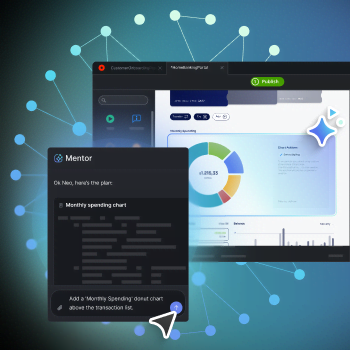
When combined with Mentor as the platform-native builder, Agent Experience translates developer intent directly into standardized, platform-compliant building blocks that adhere strictly to your enterprise architecture.
For example, YESCO, best known for designing and manufacturing the famous "Welcome to Fabulous Las Vegas" sign, is supporting and governing the delivery of AI agents into existing applications with Agent Experience. The model-neutral approach is enabling YESCO’s AI innovation while also maintaining the governance and security required for enterprise use.
“We wanted to implement agentic AI into our business, and OutSystems gave us the confidence to do it. The embedded guardrails and governance tools prevent rogue AI and protect our private information while ensuring AI remains grounded in our internal data,” says Mike Neyman, software development manager at YESCO.
Read the full story here.
Another example comes from Vopak. the world’s largest independent tank terminal operator, and its development team led by Cristiano Marques. Cristiano and the team used Agent Experience and other tech to launch an AI agent that generates living technical and functional documentation, capturing the data model, BPM diagrams, roles, dependencies, integrations, and architectural reviews.
Enterprise Context Graph
Before an AI agent acts, it needs to know what not to break. Enterprise Context Graph acts as a live GPS blueprint of your application portfolio and data. Built on over two decades of platform metadata intelligence, it continuously maps how apps, workflows, data models, and policies relate across your business. Instead of guessing or prompt-stuffing, AI tools query structural relationships upfront.
The non-negotiable enterprise outcomes
When AI coding tools are grounded in system context through Agent Experience and Enterprise Context Graph, enterprises can finally evaluate their AI investments against these non-negotiable standards:
- Repeatable: The same inputs deliver the same high-quality execution every time, eliminating AI randomness.
- Reliable: Consistent quality and architecture turn AI-generated output into production-ready software.
- Measurable: Clear before-and-after metrics demonstrate operational ROI.
- Auditable: Total decision transparency enables IT leadership and security teams to explain and trace every action taken across the lifecycle.
- Risk-managed: Governed access, approval controls, and end-to-end traceability reduce security, compliance, and operational risk.
- Economically scalable: Stable, predictable cost-per-run that CFOs can accurately model and forecast. Developers can reuse existing components and enterprise assets instead of spending tokens regenerating application scaffolding and functionality that already exists.
Building agents with full access to company data: Lowenstein Sandler
Lowenstein Sandler, a prominent national US law firm, provides tech-focused legal counsel to private equity, venture capital, and corporate clients. The firm’s development team adopted Agent Experience to accelerate app development with AI while keeping it secure.
“Working with OutSystems Agent Experience, with Enterprise Context Graph at its core, is like bowling with the guardrails up. The platform makes sure you never throw a gutter ball, keeping development running steadily and safely,” said Chris Palka, a software engineer at Lowenstein Sandler.
The team started by creating the app foundation in Mentor to build their branded user experience, and then used Claude Code to iterate on top of it. AI agents handled smaller, time-consuming tasks such as container layout, margin tweaks, and setting roles, cutting formatting work. “Agent Experience cut our app finishing time from an hour to five minutes,” said Mark DeTiberiis, another software engineer at Lowenstein Sandler.
Underpinning it all is Enterprise Context Graph, providing Lowenstein Sandler what it needs to achieve compliance, security, and audibility. That includes comprehensive logging, tracing, and identity propagation that enterprise clients require. “The Enterprise Context Graph is paramount. It’s what lets us build the right tools with full access to our data,” said Palka.
See the future of governed AI at Las Vegas World Tour
OutSystems is excited to announce that Agent Experience and the Enterprise Context Graph are officially reaching General Availability (GA).
To mark this milestone, we are hosting live, on-stage product demonstrations and revealing major new platform innovations at our upcoming Las Vegas World Tour on October 7.
If you are ready to move beyond raw AI code generation and learn how world-class engineering organizations are building secure, scalable, and governed agentic systems, you won't want to miss this.
👉 Register for the Las Vegas World Tour Now