Product Releases
and Updates

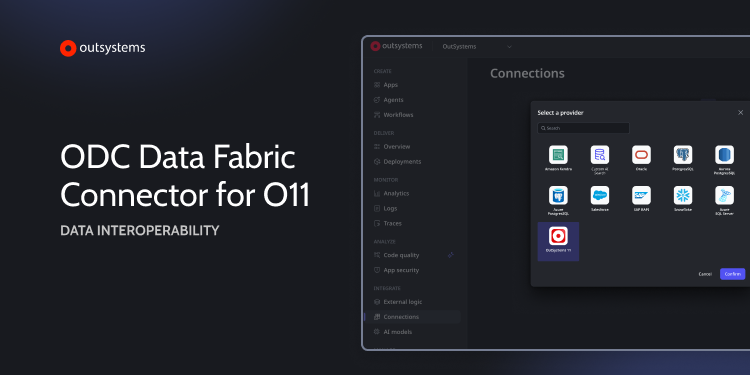
We are excited to announce the expansion of the ODC Data Fabric Connector for O11 capabilities. Following the initial release for SQL Server, we have now launched Read-Write support for O11 Oracle-based infrastructures. This release allows customers with Oracle footprints to innovate on ODC without the friction of manual data synchronization.
By enabling ODC applications to write directly back to O11 Oracle databases, we empower customers to:
- Extend Existing Apps: Build new ODC-based AI Agents or B2C portals that interact with current Oracle systems of record in real-time.
- Accelerate Time-to-Value: Reuse trusted business data without the need for complex REST API development.
- Maintain Single Source of Truth: Keep core business entities (e.g., Customer or Order data) in the O11 Oracle database while leveraging ODC's cloud-native scaling.
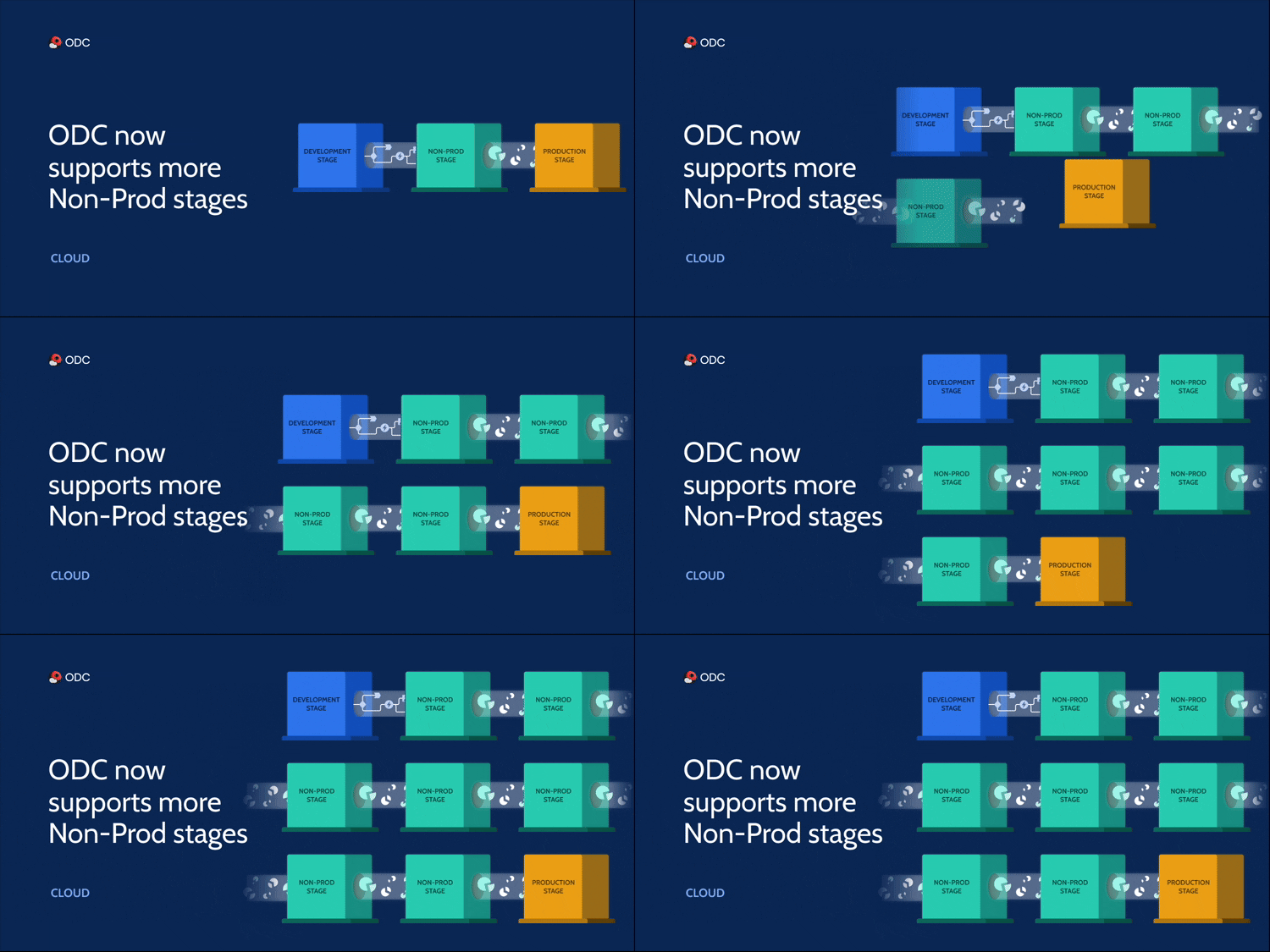
We are excited to announce an update to ODC that allows your infrastructure to grow alongside your development needs. We have officially removed the previous three-stage cap on Non-Production environments, providing the flexibility to add the additional stages required to support your unique SDLC. Whether your process requires dedicated environments for Integration, QA, User Acceptance Testing, or Staging, ODC now scales to accommodate the high-velocity delivery pipelines that modern enterprises demand.
Additional stages can be purchased separately. Click here for more information on deploying assets across multiple stages in your delivery pipeline
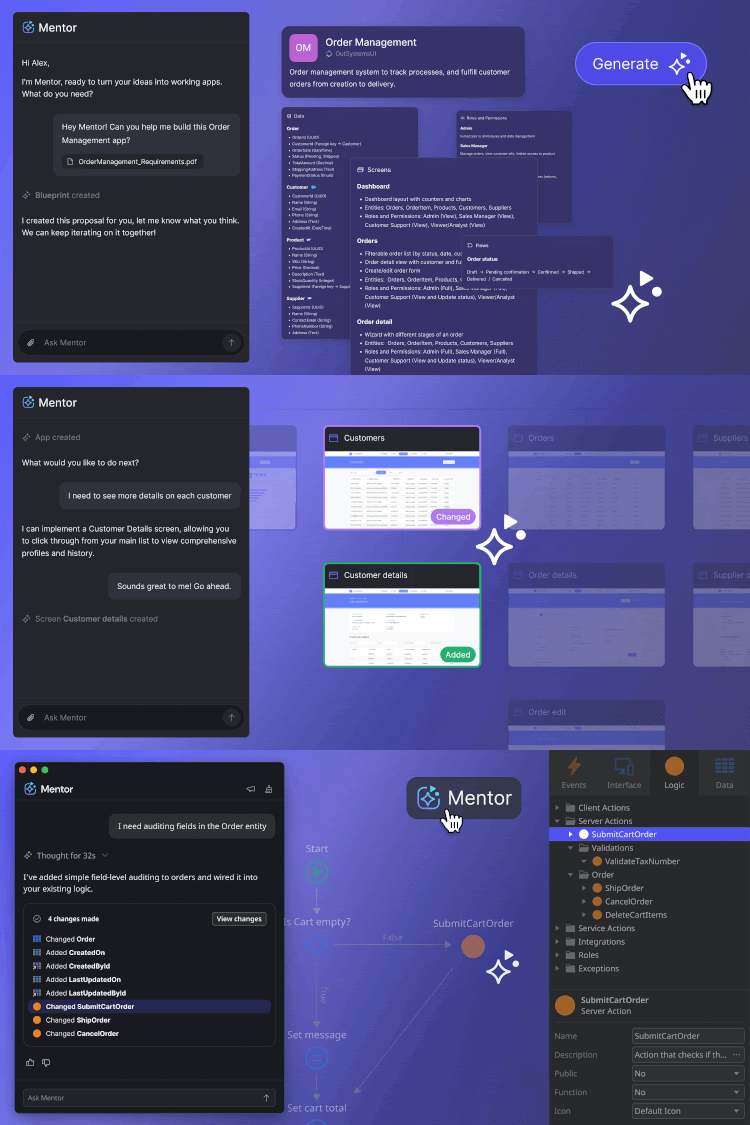
We are excited to announce the general availability of the next generation of Mentor in ODC. Designed for agentic-first development, Mentor combines the speed and power of AI with the precision of visual development, all grounded in the OutSystems Enterprise Context Graph, also known as the OutSystems model. It elevates developers into agentic systems engineers, enabling teams to move at the speed of thought while ensuring every change stays aligned with enterprise security, architecture, and operational standards.
New in Mentor App Generator
Mentor App Generator has received a major user experience upgrade. Its new conversational app generation experience enables builders to create applications by chatting with Mentor in natural language. Users can describe what they need in plain language, and Mentor asks clarifying questions as it iteratively builds the data model, logic, and user interface.
Mentor in IDE
With this release, we are bringing the power of Mentor directly into ODC Studio. Developers can now modify existing applications using natural language instead of manually navigating visual trees and configuring elements one by one. Simply open the Mentor panel and describe a goal, such as “add a comments feature to the Ticket entity” or “create a dashboard screen for order metrics.” Mentor analyzes the current application model, proposes an implementation plan, and applies changes after approval. It works across server actions, screens, entities, and logic, while respecting existing patterns, architecture, and integrations.
Better Together
Mentor App Generator and Mentor in IDE are designed to work as a single development thread. Teams can create an app in the Portal, refine it through conversation, then open it in ODC Studio and use Mentor in IDE to extend it further. Both experiences share the same application model and follow OutSystems standards for security, architecture, and code quality. Apps created through either experience are standard ODC applications, with no special handling required.
Why It Matters
AI development tools often create fragmented workflows. Mentor brings agentic speed into a unified development experience with built-in observability, security, and traceability, right where teams already build, manage, and run software. The result is faster delivery, fewer handoff points, and greater confidence that AI-driven changes are production-ready from the start.
We are excited to launch the Agent-to-Agent (A2A) connector for ODC. The A2A protocol is a standardized communication layer that allows ODC agents to programmatically discover and collaborate with external, non-ODC AI agents. By supporting a universal agent-card.json handshake, your agents can now automatically identify the skills of specialized tools like SAP or Salesforce bots. This removes manual integration friction and allows for complex, multi-turn conversations across different AI platforms. Whether triggering real-time travel rebookings or automating intelligent invoice processing across global systems, ODC now connects your entire AI ecosystem and enables seamless task delegation to your specialized external AI investments.
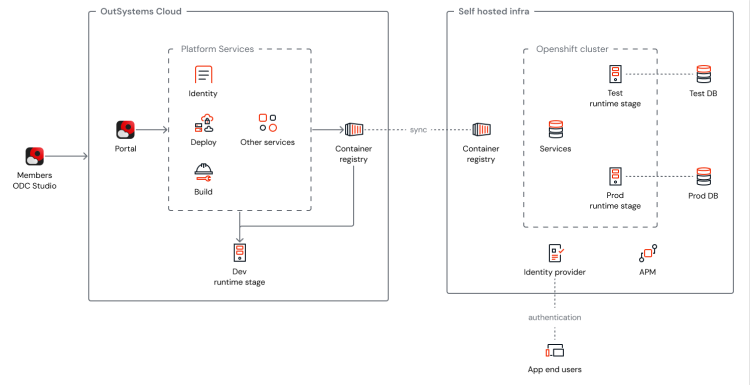
We are excited to announce a major architectural milestone for OutSystems Developer Cloud: self-hosted deployment. You can now run your mission-critical apps, data, and AI agents in your own private or public cloud, or on-premises Kubernetes infrastructure, while continuing to leverage ODC's automated platform management. By providing this deployment flexibility, we are addressing critical requirements for customers who need absolute control over their hosting environments due to stringent data residency, security, or regulatory compliance mandates.
This self-hosted model significantly enhances the developer experience by streamlining the path to production in complex network environments, particularly for high-volume on-premises workloads where remote connectivity was previously a bottleneck. By enabling single-tenant runtime provisioning directly from the ODC Portal and utilizing a secure pull mechanism for updates, businesses can achieve the agility of AI development without compromising their specific infrastructure needs. This ensures that even the most geographically distributed or highly regulated industries can scale their digital transformation efforts with confidence and efficiency.
Building AI agents is exciting—until you need to prove they actually work. When you're iterating on a System Prompt, updating Grounding Data, or wiring up new tools, the only way to know if things still behave correctly has been manual, one-off testing. Change the prompt logic, re-deploy, and hope for the best. That kind of guesswork doesn't scale, and it certainly doesn't inspire the confidence needed to put agents in front of real users.
We saw a clear need for a structured, repeatable way to validate agent behavior during development—something that lets you know, before anything reaches production, whether your changes improved things or broke them.
Introducing Evaluations in Agent Workbench
Evaluations let you automatically test your Agent Logic against a Golden Dataset—a collection of test cases with inputs, expected outputs, and expected tool calls that you define. You upload the dataset as JSON, select the Service Action that wraps your agent, and run an evaluation. The platform executes each test case, captures a full execution trace (inputs, tool calls, token usage, and final output), and then automatically scores every result using the built-in platform Judge. No configuration needed—every run gets a quality score and Pass/Fail for each test case out of the box.
This means you can change a prompt, swap a tool, or adjust grounding logic and immediately see how those changes affect accuracy and reliability across dozens of scenarios. The full execution trace gives you the visibility to pinpoint exactly where things went wrong—which tool was called, what arguments were passed, and what the agent actually produced. And because the Judge runs automatically on every evaluation, you get consistent, comparable feedback across runs without any extra setup.
We’re introducing a new widget for error management in OutSystems Developer Cloud (ODC) Workflows: a new, visually intuitive panel that helps you quickly identify and resolve issues while building workflows.
Located at the bottom of the Workflow Editor, the Notification Panel aggregates all workflow errors in one place. Instead of navigating through multiple activities and properties to track down issues, you can now instantly see where problems exist and jump directly to them with a single click.
A notification indicator shows the number of errors detected in your workflow. Clicking it opens the Notification Panel, where you can:
- Identify issues at a glance – View a clear summary of all workflow errors in one place.
- Jump directly to the problem – Click any error to navigate straight to the affected node.
- Resolve issues faster – Reduce debugging time and avoid manually searching across the workflow.
With improved visibility, navigation, and filtering, this feature makes workflow creation smoother and more efficient—so you can spend less time debugging and more time delivering value.
Storing API keys and external service credentials in site properties is a common practice, but leaving them unencrypted creates a significant security vulnerability. Relying on manual reviews to catch these oversights is risky and often leads to overlooked vulnerabilities in O11 apps.
AI Mentor Studio now automatically identifies these risks by matching site property values against typical formats for sensitive credentials and API keys.
By flagging exposed secrets early, teams can prevent accidental data exposure, enforce encryption best practices as well as ensure their applications remain compliant with modern security frameworks.
We are thrilled to announce the Beta release of ODC Semantic Search, a powerful new AI capability that helps applications and AI agents find relevant information based on meaning, not just exact keyword matches.
Introducing ODC Semantic Search
Traditional search relies on exact word matches, which can miss what a user is really looking for. Semantic Search uses vector-based retrieval to understand the meaning and context behind a query. This enables your applications to surface the most relevant information based on concepts, even when the search terms don't perfectly match the data in your OutSystems database. By transforming existing text attributes into searchable vectors, you can finally unlock the full potential of your ODC data.
Powering Apps and AI Agents
Semantic Search is more than a search experience; it is a foundational capability for building the next generation of AI-powered applications and experiences.
- Enhanced user experiences - Deliver more natural, human-like search experiences in web and mobile apps, helping users find relevant information faster and with less effort.
- Grounded AI agents and RAG - Support Retrieval-Augmented Generation (RAG) patterns by supplying AI agents with the most relevant context from your ODC data. This helps improve response quality by making AI outputs more relevant, more trustworthy, and better grounded in your business information.
Regional Support & Data Handling
For ODC environments residing in unsupported AWS regions, search requests will be automatically and securely redirected to a supported region to ensure full functionality. Learn more about it in the documentation.
Get started today
Semantic Search is currently available in Beta - we’re excited for you to try it and share feedback with us. Contact your account team and learn how to enable this powerful AI capability.
We’re pleased to announce that you can now autonomously schedule the database upgrades, security patching, and other maintenance tasks directly in the ODC Portal. The custom maintenance scheduling empowers teams to align infrastructure updates with their specific business needs, ensuring that system reliability and compliance never come at the cost of operational agility.
With this update, you get a unified maintenance dashboard with real-time progress tracking, allowing administrators to flexibly reschedule pending operations to a specific date and time within available maintenance periods. To ensure you never miss a critical update, the system sends proactive email alerts for required actions. It includes an automated fallback mechanism that securely executes necessary updates before their deadlines if no rescheduling is performed.
You can find upcoming updates and patches for app vulnerabilities under Maintain > Platform updates (formerly under App security).