



What is cloud native?
Cloud native refers to a set of approaches for building and running applications that are optimized for cloud environments—typically using microservices, containers, orchestration, and automated delivery pipelines. The goal isn’t just hosting in the cloud; it’s enabling applications to scale elastically, remain resilient under failure, and evolve rapidly through frequent, low-risk releases.
What does cloud native mean in practice?
Cloud native shows up in how teams deploy, scale, and operate software:
- Deployments are repeatable and automated (CI/CD), so updates can be shipped frequently with less risk.
- Scaling is designed-in (often horizontal), so services can handle spikes without re-architecting.
- Resilience is expected (self-healing, fault isolation), so failures don’t become full outages.
- Operations are continuous (monitoring/observability, incident response, ongoing optimization), not an afterthought.
For deeper context, explore the OutSystems Cloud Development Guide
What are cloud-native applications?
Cloud-native applications are built to take advantage of cloud capabilities—agility, elasticity, and resilience—by structuring software so components can be deployed and scaled independently.
This differs from many traditional enterprise applications, which are often tightly coupled, harder to scale selectively, slower to release, and more operationally brittle. In a classic monolithic setup, one change can require redeploying large portions of the system, and scaling usually means scaling the entire application—even if only one function is under load.
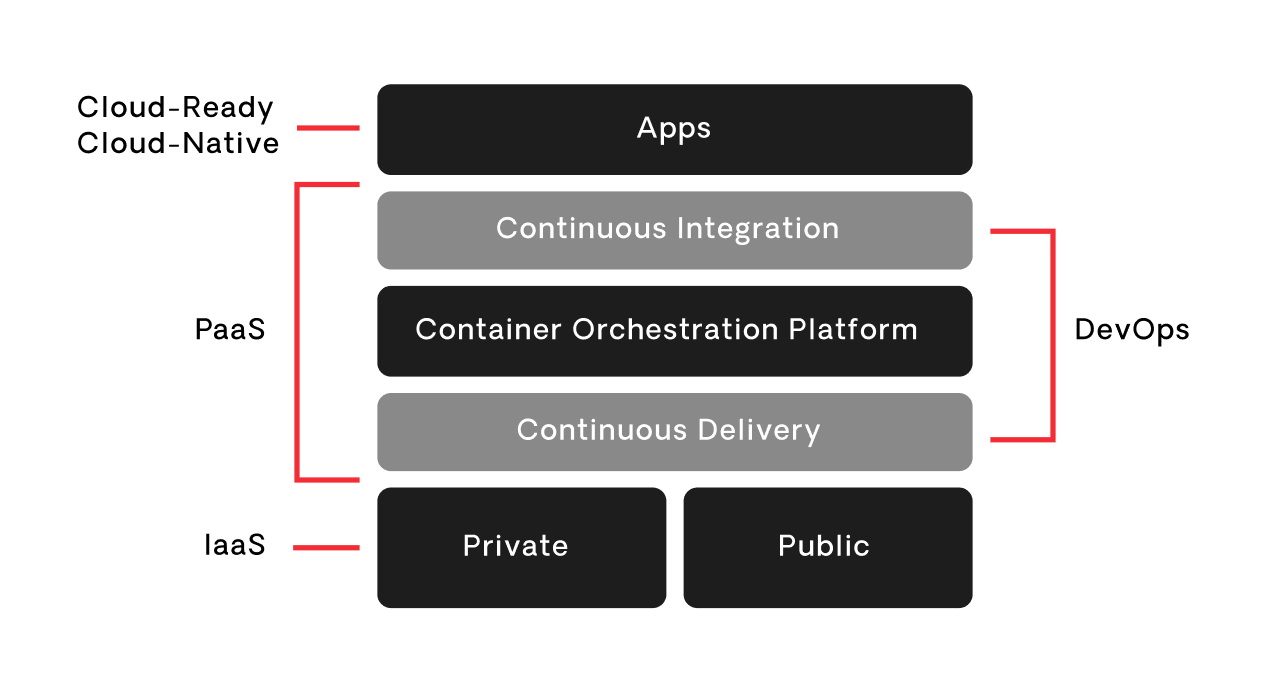
Fundamental principles of cloud native apps
Cloud-native success is usually the result of combining multiple principles, rather than adopting a single technology.
- Microservices: An application is organized into smaller services aligned to specific business or technical domains, enabling independent change and scaling.
- Containers: Code and dependencies are packaged consistently to run reliably across environments, improving portability and operational consistency.
- Orchestration: Platforms like Kubernetes automate deployment, scaling, and management of containerized services, supporting elasticity and self-healing behavior.
- DevOps + CI/CD: Automated pipelines and shared ownership improve release velocity and stability by making delivery repeatable and observable.
- Automation: Infrastructure, environments, and policies are increasingly defined and enforced through automation to reduce drift and risk.
- Resilience: Architectures are designed to tolerate failure—isolating faults, recovering quickly, and maintaining service continuity.
- Scalability + statelessness: Services are often designed to scale horizontally, with state handled deliberately (e.g., externalized) to support elasticity.
- Observability: Teams instrument services with logs, metrics, and traces to detect issues early, diagnose faster, and continuously optimize.
Industry bodies like the Cloud Native Computing Foundation (CNCF) help standardize cloud-native practices and ecosystems.
Cloud native vs cloud-based applications
Not every app running in the cloud is cloud native; some are cloud-based or hosted.
- Cloud-based / cloud-hosted: The application is deployed on cloud infrastructure, but its architecture may remain largely unchanged (often still monolithic, manually operated, or difficult to scale selectively).
- Cloud native: The application is intentionally designed for cloud operation—with patterns and tooling that enable elasticity, resilience, and continuous delivery as default behaviors.
For a deeper breakdown, see Cloud vs Cloud-Native: Understanding the Paradigm Shift
Advantages of cloud native software development
For enterprises, cloud-native development isn’t simply modern for modern’s sake. It’s a practical way to deliver digital outcomes faster, without losing control.
- Faster time to value: Modular services and automated pipelines support frequent releases and quicker iteration.
Fintech company Lendr used OutSystems to build multiple business-critical apps in under a year, including a rapid-response app launched in hours—showing how cloud-native delivery supports real business moments.
Learn more about how Lendr accelerated delivery with OutSystems
- Scalability without overbuilding: Scale the parts of the system that need it, without scaling everything.
- Resilience and availability: Self-healing and fault isolation reduce downtime and improve service continuity.
- Stronger security posture (when designed correctly): Cloud-native security practices can be embedded into delivery workflows (DevSecOps), with consistent policy enforcement.
- Cost and resource efficiency: Better right-sizing through elastic infrastructure and more targeted scaling.
- More innovation capacity: Teams spend less time on manual ops and brittle release processes, and more time delivering features customers actually feel.
For additional market context, see the Cloud Native Development Report
Cloud-native architecture explained
Cloud-native architecture combines patterns and technologies that help teams build applications that are scalable, resilient, and easier to evolve.
- Immutable infrastructure: Instead of patching servers in place, teams deploy new versions and replace old ones to reduce configuration drift and improve reliability.
- Microservices: Smaller services are independently deployable and scalable, helping teams move faster with less blast radius.
- Service meshes: A dedicated layer for service-to-service communication can handle routing, encryption, retries, and traffic policies without hard-coding those concerns into every service.
- APIs: APIs connect services and systems, enabling integration and decoupling—critical for evolving architectures over time.
- Containers: Portable packaging for services, designed for consistent runtime behavior across environments.
- Container orchestrators (e.g., Kubernetes): Automate deployment, scaling, and management of containerized services, including self-healing and scheduling.
Building blocks of cloud native architecture
Cloud-native architecture becomes real when it’s supported by concrete building blocks and consistent operating practices.
- Containers + container images: Standard packaging and versioning for repeatable deployments.
- Kubernetes orchestration: Scheduling, scaling, and self-healing for containerized workloads.
- Microservices: Independently deployable components aligned to domains or capabilities.
- CI/CD pipelines: Automated testing and deployment to support frequent, safer releases.
- Service-to-service communication controls: Traffic management, network policies, and resilience patterns to reduce failure cascades.
- Observability tooling: Metrics, logs, and traces to detect issues proactively and shorten time to resolution.
- DevOps operating model: Cross-functional ownership that aligns architecture, delivery, and operations—essential for sustainable cloud-native adoption.
How cloud-native applications are built and deployed
A typical cloud-native lifecycle looks like this:
- Design: Define domain boundaries, service responsibilities, and integration patterns.
- Build: Package services into containers, standardize configurations, and automate tests.
- Deploy: Use CI/CD to promote changes through environments with consistent, policy-driven controls.
- Operate: Monitor live behavior with observability signals, respond to incidents, and continuously optimize cost, performance, and reliability.
What to consider when developing cloud-native applications
Beyond technical choices, cloud-native development brings architectural, operational, and organizational considerations. Team autonomy, platform engineering maturity, and governance models all influence whether cloud-native delivery becomes a competitive advantage or a complexity trap.
Security and compliance
Cloud-native security works best when it’s designed into architecture and delivery:
- Align security controls to a zero trust mindset (least privilege, strong identity, continuous verification).
- Shift security left with DevSecOps practices (automated scanning, policy-as-code, secure defaults).
- Standardize secrets management, encryption, and service-to-service authentication to reduce risk as the system scales.
Scaling and performance in cloud-native applications
Scaling isn’t just “add more compute.” Cloud-native performance relies on:
- Horizontal scaling and stateless services where possible.
- Managing latency between services, especially as architectures grow.
- Designing service communication to prevent cascading failures (timeouts, retries, circuit breakers).
Disaster recovery and high availability
Resilient cloud-native systems typically incorporate:
- Multi-region strategies where business requirements demand it.
- Fault isolation so one service failure doesn’t take down the system.
- Self-healing patterns and automated recovery mechanisms.
Resource management and optimization
Cloud-native environments can waste money fast if not managed deliberately:
- Balance performance vs. cost with right-sizing, autoscaling policies, and capacity planning.
- Instrument resource usage so teams can make data-driven scaling decisions.
Monitoring and management tools
Cloud native calls for observability, not just monitoring dashboards:
- Use metrics, logs, and traces to detect issues proactively.
- Standardize alerting and incident workflows to reduce time-to-detection and time-to-resolution.
- Track SLOs/SLIs so reliability is measured and improved intentionally.
For enterprise teams, cloud-native development is a balance: move fast without sacrificing security, reliability, and governance. Our Cloud Native Development Report explores how organizations are approaching that balance—including common blockers and best practices.
Embrace innovation with OutSystems cloud-native architecture
OutSystems Developer Cloud (ODC) is cloud native by design—built to help teams deliver modern applications faster while maintaining governance, security, and lifecycle control. With ODC, organizations can adopt cloud-native approaches without turning every release into an infrastructure project.
ODC helps teams accelerate delivery and reduce operational friction with:
- A cloud-native foundation aligned to Kubernetes-based architectures
- Built-in lifecycle management across development, testing, and production
- Enterprise-grade governance and security patterns to support scale and consistency
The OutSystems edge
Cloud-native delivery gets easier when your platform supports the full lifecycle, from development through deployment and operations.
OutSystems pairs a proven low-code foundation with cloud-native delivery capabilities in ODC—including Kubernetes support and a cloud-native platform architecture—helping teams build, ship, and evolve applications faster with less risk.
OutSystems also extends cloud-native delivery with AI capabilities that speed development and help teams scale delivery—including support for building AI-powered apps and agents within a governed enterprise platform.


Cloud native frequently asked questions
Cloud generally refers to hosting and consuming infrastructure or services via cloud providers. Cloud native refers to building and operating applications in ways that take full advantage of the cloud—emphasizing resilience, scalability, and rapid delivery as default behaviors.
A common example is an e-commerce platform built as a set of microservices (catalog, checkout, payments, search), deployed in containers, orchestrated by Kubernetes, and released through CI/CD. If checkout demand spikes, that service can scale independently—without scaling the entire platform.
Cloud-native is often described as an architecture, but it’s more accurate to think of it as an architectural approach. It combines patterns (like microservices and containers) with operational practices (like CI/CD and observability) to build systems that are scalable, resilient, and built for continuous change.
Serverless is a cloud execution model where the provider manages servers and scaling, and you pay for usage. Cloud native is a broader approach that can include serverless, but also includes containers, microservices, orchestration, and operational practices like CI/CD and observability.
The Cloud Native Computing Foundation (CNCF) is an industry body that supports and standardizes cloud-native ecosystems, projects, and practices.