OutSystems Agent Workbench

Note: This post was coauthored with Alexandre Calisto.
Over the past few months, we’ve had the privilege of being part of the OutSystems team that has been conducting AI agent discovery workshops with strategic customers across the EMEA region. These sessions offered a unique perspective on the latest potential applications of AI Agents. Our findings confirm that AI is no longer experimental; it is becoming the structural core of how leading industries operate.

The frontrunners: Industry readiness in 2026
The purpose of AI discovery workshops is to identify a roadmap of possible AI agent use cases and measurable success factors for agentic implementations. Our assessment of the customers, where we jointly built an agent, reveals that the majority of the exploration sessions are in banking and insurance, public sector, and transportation and logistics. Customers in these sectors are using OutSystems to explore AI agent use cases. This aligns with recent global research highlighting the extensive activities in the field of AI from these same sectors.
Banking and insurance (30% of cases)
Banking adoption has tripled over the last four years. One customer in this sector is exploring AI agents to be used as virtual assistants to simplify complex mobile banking operations.The insurance sector shows aggressive adoption, with recent surveys indicating that 92% of health insurers are already deploying AI systems. We recognized the effort of applying AI agents in these processes with proof-of-concept validation, such as audio/video fraud detection (for example, Clientele) and automated policy onboarding.
Public sector and government (22% of cases)
Governments are entering a critical phase where the question has shifted to how to adopt agents effectively. According to insights from the Public Sector AI Adoption Index 2026, over 70% of public servants now use AI, but only 18% say governments are using it effectively. We recognize these findings and see the focus of PoCs on automating document management and complex administrative tasks to bypass legacy IT debt.
Transportation and logistics (15% of cases)
The transportation and logistics companies tend to have high volumes of data while the processes are document heavy due to, among others, customs. The data can be used by AI agents to further improve efficiencies in route/load optimization, but also support with preparing the shipments from an administrative point of view.
The low-hanging fruit: Proven starting points
The most successful first-wave use cases in our workshops typically fall into two categories: operational efficiency (45%) and risk and compliance (20%). These serve as excellent starting points because they deliver immediate, measurable ROI. The types of AI agents to support these two levers were around documents and assessments.
Operational efficiency
The prime examples here are knowledge retrieval assistants. These are chatbots that query internal manuals for employers of a logistics company (for example, how to accelerate the adoption of new core systems with employees) who effectively deflect trivial inquiries and reduce ticket volumes. Martijn Habraken, IT manager of Global Automotive Group says, “One of the first use cases for AI agents that we defined was using AI agents for supporting the employees with the adoption of new IT releases. Reducing the amount of IT Tickets and increasing the productivity.”
Risk and compliance
A use case for risk and compliance was intelligent document ingestion. Our customer saw up to 90% global efficiency improvement by automating data extraction from contracts, supporting compliance, and mitigating risks not only from business but also from IT. Another customer pushed for using AI agents in automated assessments of IT systems. The implemented AI Agent, designed to recognize error patterns in IT systems, could reduce manual analysis time by nearly 80% to 85%.
Less suitable use cases
On the other end of the spectrum, we found that a significant portion of requested use cases were less suitable candidates for AI. Many smart features don't require cognitive simulation or probabilistic reasoning, Instead, they require deterministic precision.
A possible use case that came up was around building a similar-products engine based on deterministic attributes, such as category, price range, or technical specs. This is an example of a feature that can be more efficiently handled via standard query filtering or full-text search. In these instances, a well-tuned algorithm provides 100% predictability and lower latency, whereas AI introduces unnecessary complexity. Therefore, besides a roadmap for AI agents, the session also formed a valuable opportunity for business and IT to get ideas for new features for their existing applications as a bonus.
What’s under the hood? Why RAG was the backbone of our PoCs
Back to the use cases that were identified as suitable AI agent applications. Across our various agentic implementations, retrieval-augmented generation (RAG) has emerged as the clear frontrunner. Alexandre Calisto, Head of PS AI experts EMEA, explains why: “While standard AI models are incredibly smart, they are limited to the information they were "fed" during training, which doesn't include your organization's business data and specific knowledge.”
What is RAG?
Think of RAG as giving the AI an open-book exam. Instead of relying purely on memory, the system first searches through your specific documents, manuals, contracts, spreadsheets, and others to find the right context before it ever starts thinking.
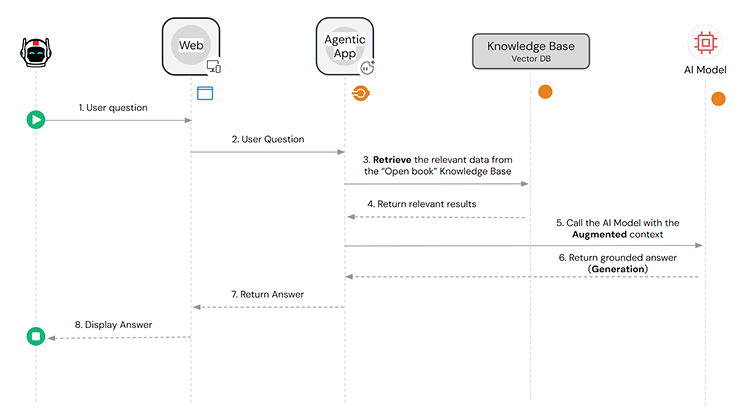
Sequence diagram with RAG agent with vector DB (KB) example
Why is it the go-to pattern?
Here are the reasons why RAG is the frontrunner:
- Accuracy: It drastically reduces hallucinations (AI choosing what its model says is statistically the best answer, not the most accurate) because every answer must be grounded in a retrieved source.
- Security: You don't need to retrain the model on sensitive data; the AI simply "reads" the data from your knowledge base (for example, a vector database).
- Up-to-date: If you update your knowledge base today, the AI will use that new information immediately.
By providing this dedicated knowledge base, RAG transforms a general AI into a specialized expert tailored to our unique business needs.
The future: Shifting to multi-agent ecosystems
While current projects often focus on single-threaded automation, recent research (see the references at the end of this post) indicates a rapid shift toward multi-agent systems (MAS). In 2026, we expect to see more of:
- Collaborative AI workflows: 57% of organizations are already deploying multi-step agent workflows that can plan and execute across distributed environments.
- Domain-specific innovation: Rather than generic models, enterprises are demanding Domain-Specific Language Models (DSLMs) that understand unique business contexts with higher accuracy and built-in compliance, especially when the business workflow is well known.
- Agentic orchestration: The focus is moving from just building agents to operating them reliably, using frameworks that manage the full agent lifecycle and ensure human-in-the-loop governance.
This point of view was confirmed by the majority of the customers, indicating that multiple platforms are providing the possibilities of building AI agents. Martijn Habraken says, “The AI discovery workshop provided a first step in establishing an AI agent roadmap covering multiple platforms supporting the end2end, I believe the biggest value lies in orchestrating the AI Agents from different platforms in one collaborative workflow.”
The journey from discovery to production is accelerating. By focusing on these proven patterns, our customers are moving beyond isolated pilots to build a resilient, AI-powered future. AI discovery workshops have proven to be a potent session to facilitate this motion. If you are interested in organizing an AI Agent discovery workshop for your organization, reach out to one of our experts.
[1] References: