How Technology Can Revolutionize The Adoption Process

At BEB, we imagine a world where every child grows up in a safe, loving family. Unfortunately, more than five million children live in institutions today. Without a family, these children face higher risks of trafficking, exploitation, and lifelong trauma. Because many organizations still rely on scattered paper records, these children remain invisible to the systems designed to protect them. We are using OutSystems to change that. That is the power of technology.
Who is BEB?
BEB is a non-profit organization with over 15 years of experience. We operate in regions with many institutionalized children, primarily in Latin America and Africa.
The inspiration for BEB came from a personal experience. In the early 2010s, our founder, Craig Juntunen, went through a very challenging adoption process. He adopted three children from Haiti, but faced significant delays and monetary issues. The system just didn’t work the way it should.
So, Craig decided to fix this problem. He invited representatives from 14 countries to Harvard to find ways to make the adoption process more efficient and less traumatic for children and parents. Every representative gave the same answer: technology.
Understanding the problem
The primary problem is that most children living in institutions lack a digital identity. They often lack birth, medical, or school records. Even when this data exists, it usually lives on paper, which creates massive risks. Paper records can disappear, or a disaster can destroy them, erasing the only proof that a child exists.
Furthermore, physical paperwork slows down every step of the process. Because of this, local governments responsible for protecting these children do not know how many live in institutions or who they are.
So that’s where we started. We wanted to give every child a digital identity and restore rights to children who were previously effectively invisible, with the goal of seeing more children grow up in families instead of institutions. This goal became the foundation for Children First Software, a web-based application we built using OutSystems.
Children First Software: A 5-step plan from institution to family
Children First Software (CFS) is a modular application that we provide for free to childcare institutions (aka orphanages). The app follows the principles of the UN Convention on the Rights of the Child and guides institutions through a five-phase process to put children on a path to a family. We design these plans in collaboration with local governments.
The process begins by creating a digital profile for each child and continues even after the child reunites with relatives or joins an adoptive family. Using CFS, institutions also collect data on the relatives and prospective parents to define the best path for each child, following the government-sanctioned plan.
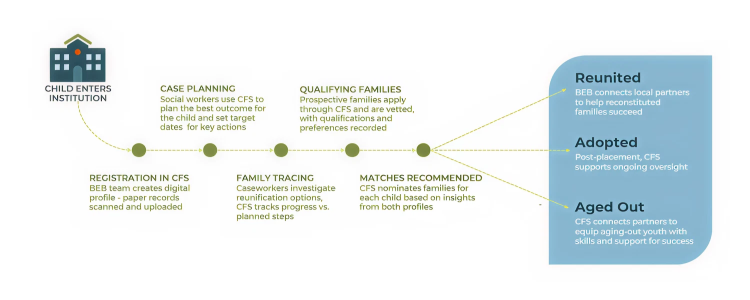
Image description: CFS 5-step plan.
Why we chose OutSystems
We built CFS using OutSystems in partnership with Tyler Technologies, an IT company that provides over 50% of the court and justice software in the United States.
As a small team of just four full-time developers, we needed a platform to maximize our productivity. We wanted to launch the first version of CFS quickly but we also needed to evolve it as new needs emerged. We also required a secure platform we could trust with sensitive personal information. After all, we are protecting children’s data.
OutSystems had everything we needed:
- A modular-driven development architecture allows us to reuse the code we build and simplifies governance.
- Built-in security mechanisms, like role-based access control, limit the child data that users can view and update.
- Integration with AWS moves the burden of infrastructure management off our shoulders and the limited IT staff of our government clients.
- Disaster recovery mechanisms allow us to restore the system quickly after a catastrophe, a vital feature for the regions where we operate.
Most importantly, OutSystems gives us the agility to tailor CFS to unique requirements. We work across 14 countries, each with different regulations, cultures, languages, even dialects. OutSystems helps us build CFS as a highly flexible and dynamic solution. In fact, we’re launching new features and enhancements quarterly while keeping a very lean team.
How CFS helped reunite Fekadu with his mother
More than 1000 childcare institutions across 20 countries have rolled out CFS, resulting in over 80,000 children registered and 14,000+ placed into a family. One of those children is Fekadu from Ethiopia. He was separated from his family as a young child because they didn’t have the financial conditions to support him at home.
He lived on the streets at night, but during the day, he visited an orphanage that had implemented CFS. After ten years of searching, his mother finally found him thanks to his digital profile.
Looking forward
We want to continue expanding CFS into new institutions and into new regions, while making the solution more reliable and easier to use every day. This is how we can help more children like Fekadu find their happy story. With OutSystems as our partner, we’re building hope.