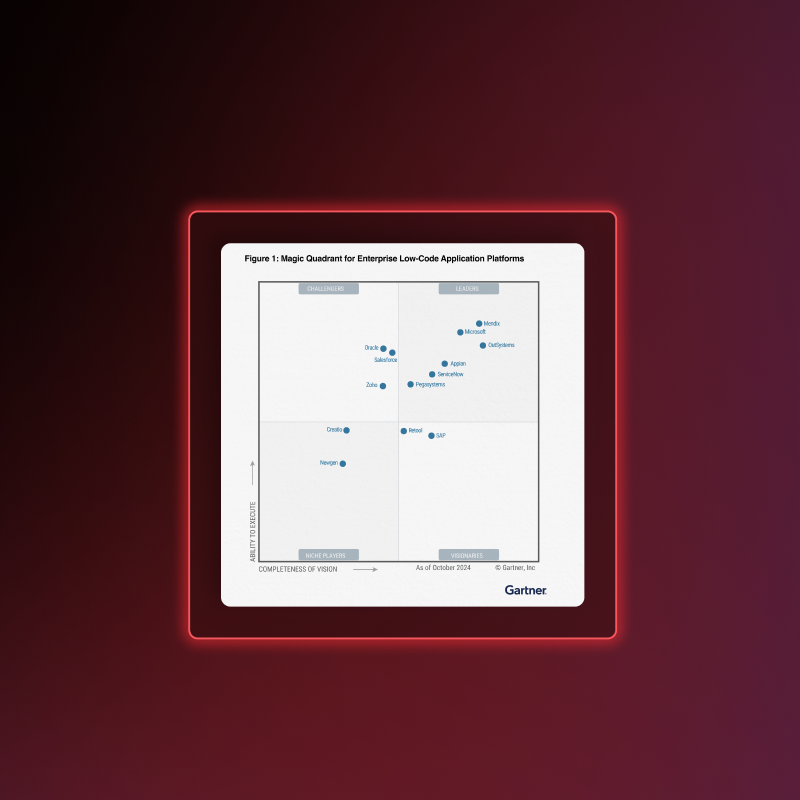
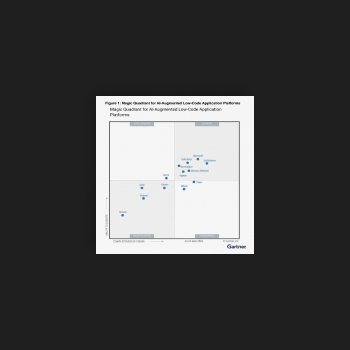
2024 Gartner® Magic Quadrant™ for Enterprise Low-Code Application Platforms: Positioned Furthest on Completeness of Vision
In the report, you can learn the criteria that Gartner used to position us the furthest for Completeness of Vision among other vendors. We also think that the following aspects of what we offer as a vendor contributed to our inclusion:
- Leadership in advanced GenAI-powered app generation: Formerly known as Project Morpheus, Mentor is our innovative offering that leverages advanced generative AI (GenAI) capabilities to revolutionize application development.
- Strong partner network: The OutSystems partner program accelerates customer success, pace of adoption, and time to value.
- External-facing applications: OutSystems is committed to helping customers build top-rated solutions that deliver superior customer experiences across multiple industries.
OutSystems believes this recognition from Gartner reflects our commitment to helping enterprises solve their most costly and complex problems through pioneering innovation.
But OutSystems also thinks that our platform is at the heart of what makes us visionary. From our viewpoint, the visionary nature of our platform makes us an excellent choice for anyone considering a low-code platform.
5 reasons why OutSystems believes our platform is visionary
When someone asks why we believe the OutSystems low-code platform is visionary, we have a number of reasons. Here are the top 5.
1. The OutSystems platform is built to evolve
To make sure that developers do not work with outdated technology, we've anticipated nearly every shift in the market. This goes all the way back to the founding of OutSystems, from pioneering the concept of a platform-as-a-service to embracing iterative development and Agile, DevOps, mobile application development, cloud, composable architecture, and more. Our platform reflects our commitment to ensuring that neither it nor the software built with it ever becomes stale. When new technologies, architecture, or methodologies come along, OutSystems is right there with them, ready to adapt and evolve.
2. Our platform has been powered by AI since 2018
In 2018, we began building artificial intelligence into our platform—long before the frenzy started. Today, AI-assisted development and deployment is an integral part of OutSystems. In 2024, we introduced AI Agent Builder, which developers can use to create GenAI agents using Large Language Models (LLMs), Retrieval-Augmented Generation (RAG), and natural language processing—regardless of their AI experience level. And not even 6 months later, we announced Mentor, a digital worker that supports your team through every stage of the SDLC, from concept to ongoing maintenance. Powered by AI and GenAI, it can boost developer productivity, offload tedious tasks, and ensure that your team delivers high-quality apps.
3. The OutSystems platform pushes the boundaries of cloud-native
A 2024 study of cloud-native application platforms reports that 93% of organizations are transforming their business with a cloud-native architecture. OutSystems has been prepared for this shift, which is why the platform has supported Kubernetes, Linux containers, microservices, all on a foundation of native cloud services since 2022. And that set us up to give developers access to Netflix-level infrastructure on demand. Earlier this year, we launched OutSystems event-driven architecture. Rather than responding synchronously to sequential updates, it asynchronously responds to events. Now it’s possible to build responsive, scalable, highly performant apps for streaming, credit card transaction processing, geospatial advertising, ecommerce, public transportation, and more.
4. OutSystems Data Fabric makes data more accessible
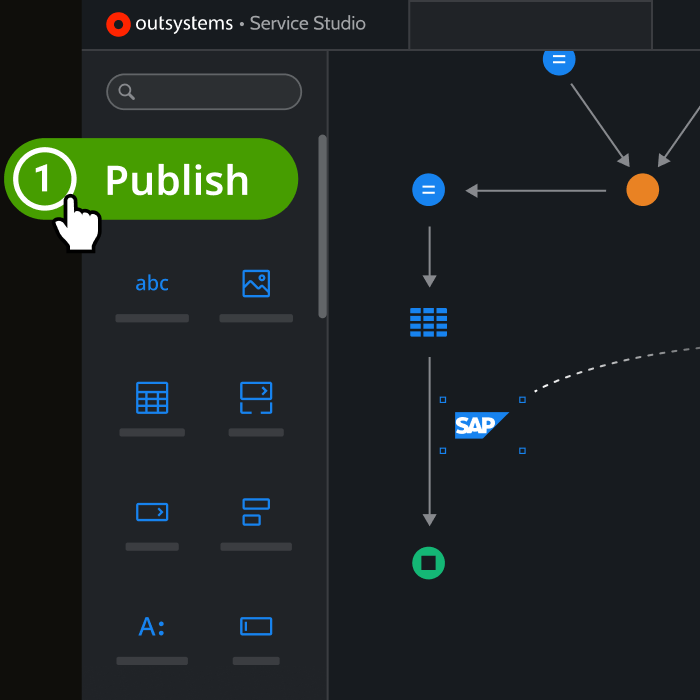
Accessing, discovering, combining, and reliably retrieving data can be time-consuming, requiring a lot of thought and effort during the application development process. Data fabrics have emerged to mitigate that challenge, and we have already woven our own into our platform. OutSystems Data Fabric is an advanced virtual data layer that makes it easier to add data-based functionalities to applications, consolidating multiple sources into a custom data set. Developers can query and create data mashups from those sources, in a single relational or non-relational data experience, freed from the struggle of making enterprise data available for apps. OutSystems Data Fabric also removes the complexity of setting up connections to external databases or systems.
5. The OutSystems platform demonstrates our commitment to the developer experience
OutSystems was built by developers for developers. For that reason, we are committed to adopting new technologies and methodologies to ensure that the developer experience—from building that first software prototype to application lifecycle management—exceeds expectations. We have listened to developers throughout our history, and we even used their feedback to improve the platform. After all, who knows better how to improve development than a developer? From adding GenAI to the platform, opting for an event-driven architecture to removing the hassles of data access, and automating the tedious parts of SDLC management, we’ve got developers covered.
And as technology marches on—as it invariably does–OutSystems will be there, weaving the best parts into our platform.
Evaluating low-code platforms?
Get your copy of the Gartner® Magic Quadrant™ for Enterprise Low-Code Application Platforms.
The report was titled as ‘Magic Quadrant for Enterprise High-Productivity Application Platform as a Service’ from 2017-2018.
GARTNER is a registered trademark and service mark of Gartner and Magic Quadrant is a registered trademark of Gartner, Inc. and/or its affiliates in the U.S. and internationally and are used herein with permission. All rights reserved. Gartner does not endorse any vendor, product or service depicted in our research publications, and does not advise technology users to select only those vendors with the highest ratings. Gartner research publications consist of the opinions of Gartner's research organization and should not be construed as statements of fact. Gartner disclaims all warranties, expressed or implied, with respect to this research, including any warranties of merchantability or fitness for a particular purpose.